
Badge Kids › Road Badge › Section 8 › Lesson 8.3
All courses›Road Badge›Section 8
Two different ways round a thing
Tell a rock dodge from a snap turn, say which threat each one is for, and keep off the brakes in the middle of either.
1Watch
Seen at four metres
Seen at four metres
Rider's eye view along a bike lane at a steady pace; a fist-sized chunk of broken kerb appears out from behind the shadow of a parked van about four metres ahead, directly under the front wheel's line; the frame freezes there.
14 secondsToo close to brake for and too small to be worth a whole change of direction. This is the situation the cycling schools built a separate skill for, and most riders have never heard of it.
2The idea
Motorcycling has one move here and cycling has two
The motorcycle course calls it swerving and teaches one manoeuvre. Cycling curricula split it in two, because a bicycle can do something a motorcycle cannot: move the front wheel sideways without moving the rest of itself.
The rock dodge is for a small object spotted late, where your line must not change. The snap turn is for a real change of direction — a car pulling out, a door, something across the whole lane. Different threats, different moves, and using the wrong one is worse than using neither.
3The idea
The rock dodge, and why it works
The instruction is almost physical: quickly flick the front wheel around the object — the wheel weaves quickly to one side, then the other, while your bike and your body maintain a straight line. A snap left, a snap right, and you are past it. Your shoulders do not move and neither does your line.
And here is the part that makes it a real skill rather than a trick: the back wheel is allowed to hit the thing. Front-wheel contact is what puts riders on the ground. Rear-wheel contact over the same object is far less likely to cause a crash. So the rock dodge does not try to save both wheels. It saves the one that matters.
4Your turn
Snap, snap, straight on
The dodge
A rider's-eye run down a lane with small objects appearing at random on your line, spaced a few bike lengths apart. Two keys snap the front wheel left and right; a third steers the whole machine. Your line is drawn behind you as you go. Get past the objects with the drawn line still straight.
Try it first with the steering key, the way most people would. Watch what your line does, and then look at how far into the next lane you have wandered by the fourth object.
5The idea
The snap turn, which has four steps and two warnings
For a genuine change of direction:
Flick the wheel briefly the opposite way to where you want to go.
Turn your head towards the turn and look where you want to end up.
Keep the inside pedal up.
Let the machine lean, and go where you are looking.
The two warnings are written in capitals in the source and both belong to this course. Never touch the brakes once it is leaning — the back wheel lifts and slides out. And tyres with a knobbly off-road tread may not grip pavement, which is a live warning for a lot of fat-tyre e-bikes. Learn it slowly, and never learn it at speed.
6Decide
A car noses out of a driveway across your lane, twenty metres ahead.
Pick one to carry on.
7Look
What the test actually measures
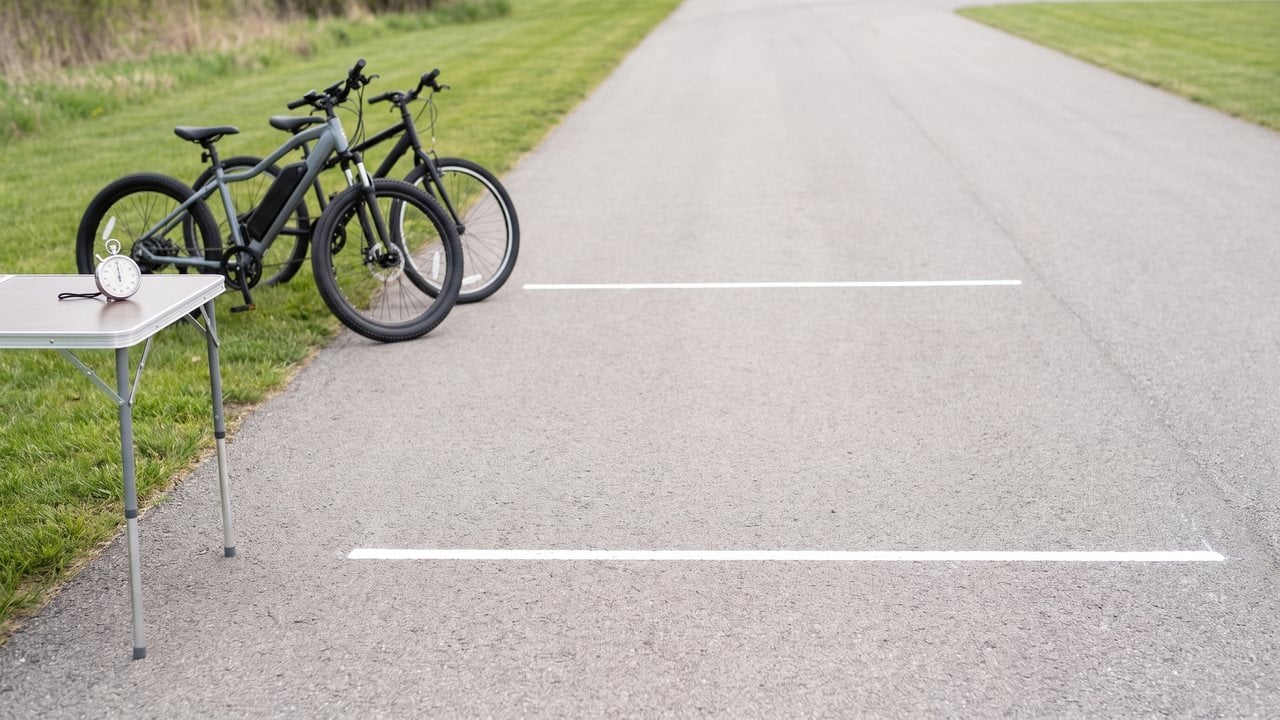
That is the fourth and last item of a riding test that is four exercises long. There are painted lines, a measured distance and a stopwatch, and it is the reason nobody claims a screen can certify this.
8Find them
Which of these belong to the rock dodge?
Tap the ones that count.
Find all 3.
9Say it
One line that covers both moves
Say it out loud, in your normal voice
“Wheel round it, or all of me round it. Never both hands braking.”
Say it before each practice run so the choice is made before the object appears. The moves themselves are quick. Deciding which one you are doing is the slow part, and it is the part you can do in advance.
10Do it
Before you leave this page
Lay a line of beanbags, chalk marks or paper plates along your riding line in the empty lot, four to six feet apart, the way the school drill sets it up. Ride the line at a steady speed and snap the front wheel round each one. Your witness stands at the far end and ticks a run only if you got past them all with your body going straight down the line and no weaving.
Tick it when you have done it.
Lesson done.
Small thing, seen late: the front wheel goes round it and you do not. Big thing: the whole machine goes round it and your eyes go first. Brake before or after, never during.
Next lesson: You get one of them, not bothSection 8 · When It Goes Wrong
8.1Why this is the last badge and not the first8.2The quick stop, and the pedals that are not where you think8.3Two different ways round a thing8.4You get one of them, not both8.5The dog, and two manuals that disagree8.6Gravel, grates, rails, and the last skill in the course★Section check