
Badge Kids › Road Badge › Section 5 › Lesson 5.5
All courses›Road Badge›Section 5
Four feet, and whose offence a dooring is
Hold a line outside the door zone past a row of parked cars, and say why the offence belongs to the person opening the door.
1Watch
The door that had nobody in it a second ago
The door that had nobody in it
A rider comes along a line of parked cars with about a foot of space between their shoulder and the wing mirrors; a driver's door begins to swing open two cars ahead, and the frame freezes with the door half out and the rider still coming.
18 secondsThe rider has done nothing wrong and had no warning worth the name. Everything that matters here was decided further back, by how far out they were riding.
2The idea
It has a measured width, and the number is four feet
This is not a feeling or a rule of thumb. The door zone is four feet wide — the strip of road next to a parked car that a car door swings into when it opens. A rider inside that strip is riding in a space that can be filled without warning by something solid and immovable.
The training standard puts the same idea in words rather than numbers: riders must understand the importance of riding at least a door’s length away from stationary vehicles. Same instruction. One of them you can chalk on the ground.
3The idea
Whose offence it is, and why that is worth knowing
The law in one real state says it flatly: no person shall open the door of a vehicle on the side available to moving traffic unless and until it is reasonably safe to do so, and a door may not be left open longer than it takes to get in or out. Most places have a version of this.
So a rider hit by a door was hit by somebody breaking a rule. That matters for how you think about it afterwards, for how the adults around you handle it, and for the insurance conversation. It is also completely useless at the moment of impact, which is why the rest of this lesson is about where you ride.
4Look
Four feet, drawn on the ground
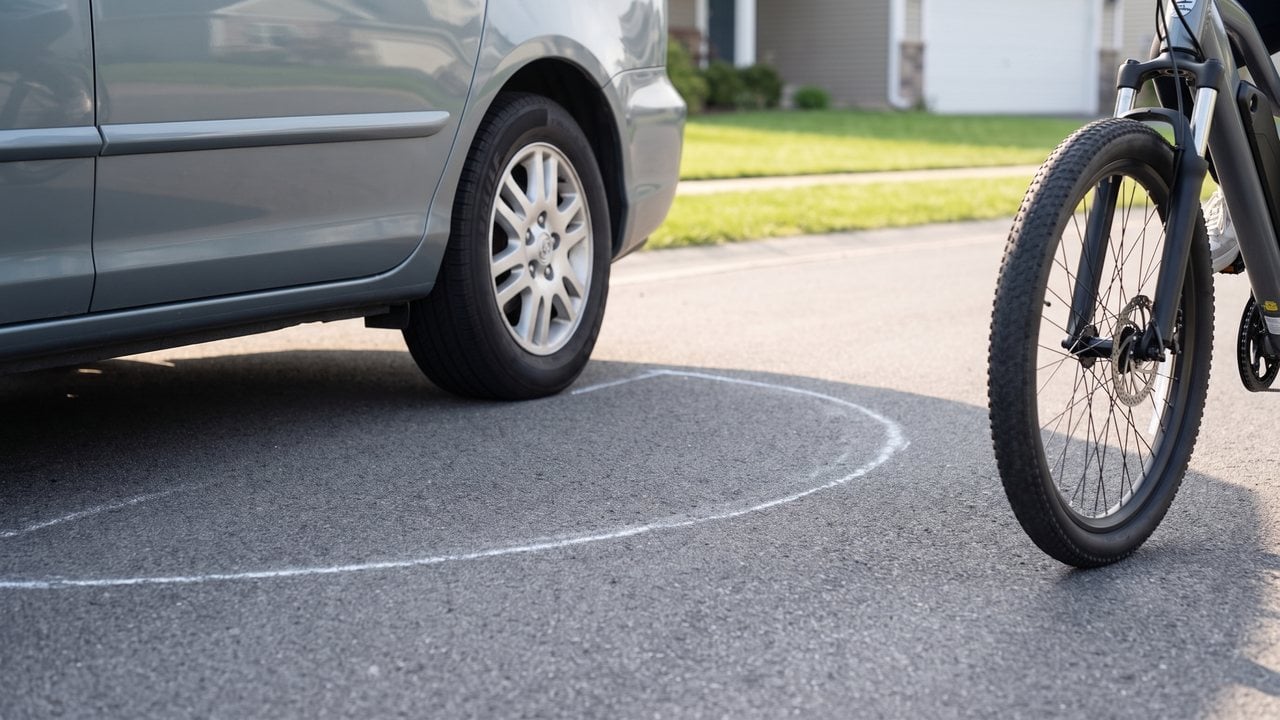
Somebody has drawn on the road here so the argument stops. The tip of that door is a fixed thing, it is the same for nearly every car on the street, and you can go and measure it tonight.
5The idea
The finding that says slogans do not work
On a studied city street with a bike lane painted right up against the parked cars, hardly any riders rode outside the door zone. Then a two-foot buffer was painted in, and forty per cent of riders rode outside the door zone. Which is a real improvement, and it also means sixty per cent still rode inside it with the paint right there.
Riders do not naturally hold a line away from parked cars. The instinct to stay right is strong, the paint is reassuring even when it is in the wrong place, and knowing the phrase door zone does nothing on its own. It is a line you practise until your hands do it, not a fact you learn.
6Decide
A painted bike lane runs the whole way along a row of parked cars, right up against them.
Pick one to carry on.
7Your turn
Pick your line
The whole row
A street with twelve parked cars and a line you draw for yourself with a finger. Two of the cars have somebody sitting in them and two more have brake lights that have just gone off. Draw the line, then watch it play back with doors opening at random and the four-foot zone shaded in.
Try a line that swerves out only for the cars with people in them, then try one straight line held outside the whole row. Watch which of the two is easier for the driver behind you to predict.
8Find them
Which of these are true about the door zone?
Tap the ones that count.
Find all 4.
9Say it
The line for a row of parked cars
Say it out loud as you come up to the row
“A door's length out, all the way past.”
The second half is the part that gets dropped. Riders move out for the car they are worried about and drift back in for the next four, which puts them back in the four feet for most of the row.
10Do it
Before you leave this page
With an adult, go to a parked car on a drive and have them open the driver's door as far as it goes. Chalk a line on the ground at the tip of it. Then stand where you would normally ride past a parked car and look at which side of that chalk line you are standing on. Say the answer out loud.
Tick it when you have done it.
Lesson done.
The door zone is four feet wide. Ride outside it for the whole row, not just past the car with somebody in it.
Next lesson: Junctions, both left turns, and the strategy that comes lastSection 5 · You Are Traffic
5.1You are traffic, and here is the sentence that says so5.2The two positions, and both of them have names5.3Control and release, which has the give-back in the name5.4The rule everybody quotes in half5.5Four feet, and whose offence a dooring is5.6Junctions, both left turns, and the strategy that comes last★Section check