
Badge Kids › Road Badge › Section 4 › Lesson 4.2
All courses›Road Badge›Section 4
The drill that proves you actually looked
Look behind and correctly call what somebody is holding up, standing still first and then riding a straight line, without the line moving.
1Look
Three fingers
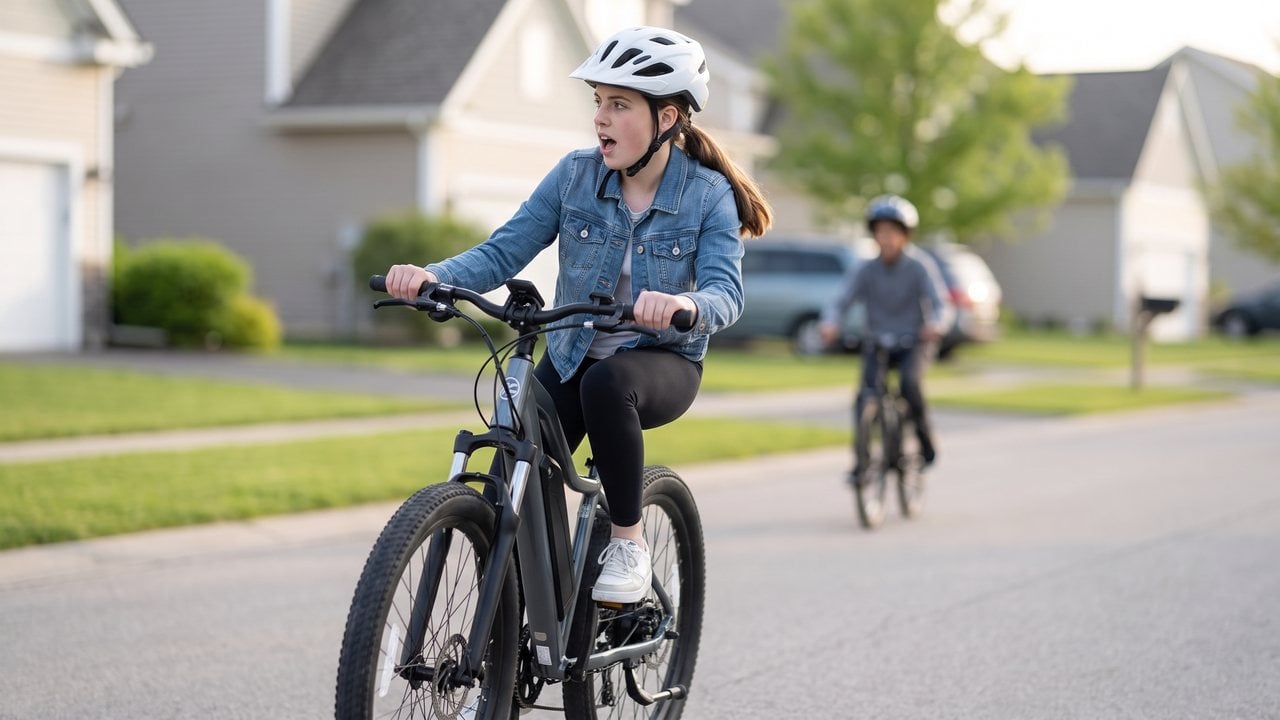
Nothing in that picture is a test of how far your neck turns. Either a number comes out of your mouth or it does not.
2The idea
Why the drill has an answer in it
An American cycling school teaches it like this: one rider follows another in a straight line holding up one to five fingers, and the rider in front looks back and calls out the number. That is the whole drill, and there is no equipment in it.
It is built so that you cannot fake it. A rider can turn their head, take in nothing and carry on, and from behind that looks identical to a real look. A number cannot be faked. Either you processed what was behind you or you said the wrong thing.
3The idea
Do it standing still first
A state school curriculum builds a version with a scaffold under it. Somebody holds the machine upright while you sit on it and practise looking over your left shoulder, and they hold up a card that either shows a car or is blank. You say car, or no car.
That order is deliberate and worth copying. The stationary version separates the looking problem from the balance problem, so you are only fixing one thing at a time. Then the same drill moves: you ride, they follow or stand at the side, they call out, and you say what you saw.
4The idea
Then put it in the corridor
The last version puts both halves together. Ride the chalk corridor from the badge before — a foot or two wide, twenty to thirty feet long — and do your looking inside it. The racing body lists looking back as one of the things that corridor exists for.
Now two things get measured at once. Did you call the right number, and did you touch a line. A rider who gets the number right and puts a wheel outside the corridor has done half of this skill, and knowing which half is missing is the entire reason for drawing the lines.
5Decide
You look back, face front again, and realise you could not say what was behind you.
Pick one to carry on.
6Your turn
Call it out
The number behind you
A rider on a line with a follower behind. Press to look, and the view behind flashes for half a second, then a second, then two. Call what you saw. The card records how long you needed and whether your line moved while you took it.
Start at half a second. Most riders need longer than they expect, and finding that out on a screen is cheaper than finding it out on a road.
7Find them
Which of these count as a real look behind?
Tap the ones that count.
Find all 3.
8Say it
Name what is back there
Say it out loud, in your normal voice, on every practice look
“One car, and it is holding back.”
Saying what is behind you out loud is what turns a look into information. Do it on every practice look, then on real rides with nobody listening, because the sentence is the proof to yourself that you saw.
9Do it
Before you leave this page
Get somebody to stand a few metres behind you holding up fingers. Do it sitting still first, with them holding the machine: ten looks over each shoulder, calling the number every time. Then ride a straight line and do ten more. They keep score of two things – right number, and whether the line moved.
Tick it when you have done it.
Lesson done.
Turning your head is not looking. If you cannot say what was there, you did not see it.
Next lesson: Riding one-handed without going anywhere