
Badge Kids › Road Badge › Section 4 › Lesson 4.1
All courses›Road Badge›Section 4
Why looking back makes you swerve
Say why a rider drifts when they look behind, and hold your line through a full look using the stiff-arm method on both sides.
1Watch
The look and the drift
The look and the drift
A rider goes down a chalk line, turns their head to look over the right shoulder, and the machine drifts about a foot and a half to the right; the frame freezes with the front wheel off the line and the rider still looking back.
15 secondsThat rider did exactly what they were asked to do. The drift was not carelessness. It was the machine doing what their shoulders told it to.
2The idea
The gate that every programme puts right here
The UK national cycle training scheme has two criteria at the end of its traffic-free level: look behind over each shoulder while pedalling in a straight line, and pedal one handed in a straight line. Then it writes the gate in plain words — demonstrating that whole level is a prerequisite for going out on roads at all.
It looks like the smallest skill in this course and it is the one everything on a road is built on. You cannot join traffic until you can take your eyes off where you are going, and a hand off the bars, and still be exactly where you were.
3The idea
The mechanism, and it is not about balance
The training article says it in one line: a bicycle is steered as much by the hips and shoulders as by the hands. Twist right, and you drift right. Your arms connect you to the handlebar, so a torso that rotates takes the bar with it by a few degrees, and a few degrees is all it takes.
One American source offers a second explanation about the balance organs inside your head and the fluid in them moving when you turn. We could not find research behind that one, so we are flagging it rather than teaching it. The shoulder explanation is the mechanical one, and it is the one the fixes actually work on.
4The idea
Three fixes, and the middle one is the one to learn
An American cycling school teaches three of them.
Relaxed: arms loose and slightly bent, turn only your head. Fine for a very quick look.
Stiff arm: lock out the elbow on the side you are looking and tuck your chin down to that shoulder. The locked arm physically stops the shoulder rotation reaching the handlebar.
Full rotation: sit up, take one hand off, turn the shoulders.
Learn the stiff arm first. It is the one that works for a real look rather than a flick, it does not need a hand off the bars, and it is the one that turns a foot of drift into none.
5Decide
You look over your right shoulder and the machine goes right with you.
Pick one to carry on.
6Look
Where the twist stops
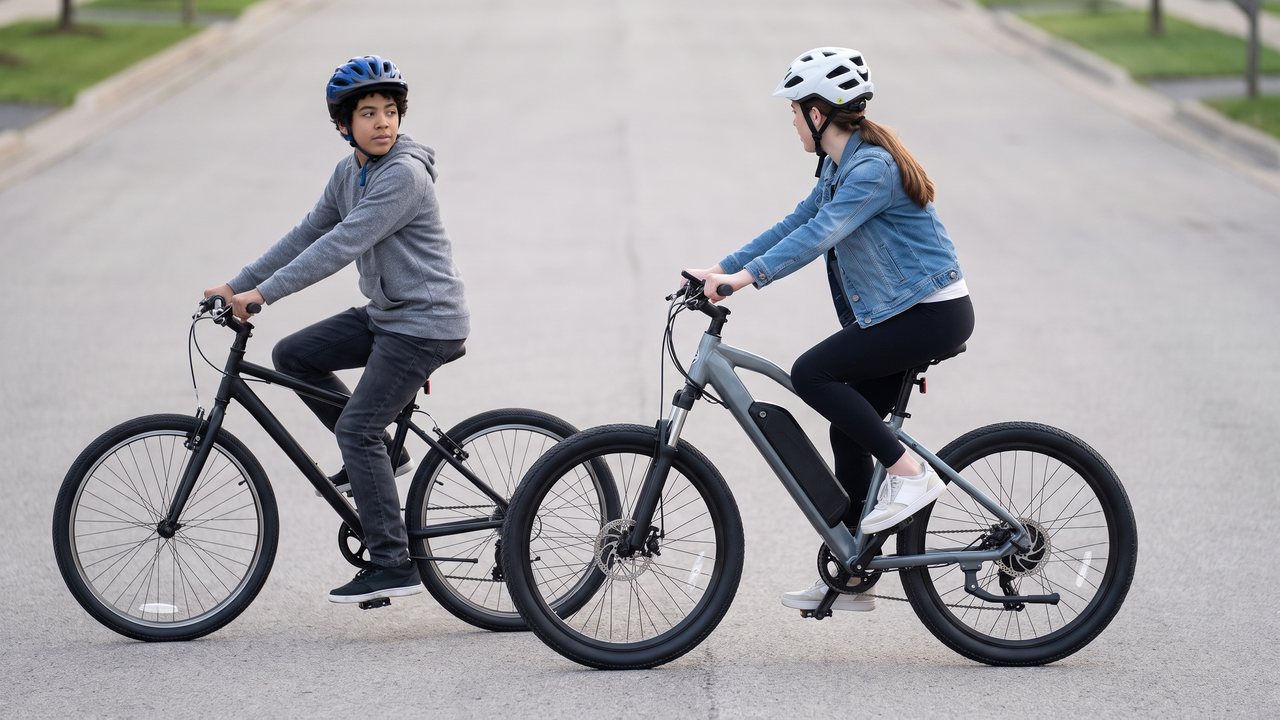
Same head position in both pictures. The only difference is one straight arm, and it is the whole difference between a foot of drift and none of it.
7Your turn
Turn the shoulders
Where the twist goes
A rider seen from above on a straight line. A slider turns their head and shoulders round. Toggle between loose arms, a locked elbow and a hand off the bar, and watch how much of the shoulder rotation reaches the handlebar and how far the line bends.
Push the slider all the way with loose arms first, so you can see how little rotation it takes to move a front wheel.
8Find them
Which of these help you hold the line through a look?
Tap the ones that count.
Find all 4.
9Say it
Two things before every look
Say it out loud on the practice runs
“Lock it. Chin down.”
Say it out loud on the first twenty looks and the arm starts doing it before your head turns. After that it stops being a technique and becomes just how you look behind.
10Do it
Before you leave this page
In your practice space, ride a chalk line and look over your right shoulder with that elbow locked and your chin to your shoulder. Then the same over the left. Ten each way, with somebody watching the front wheel and telling you honestly whether the line moved.
Tick it when you have done it.
Lesson done.
The machine follows your shoulders. Lock the elbow, chin to that shoulder, and the line stays where it was.
Next lesson: The drill that proves you actually looked