
Badge Kids › Road Badge › Section 3 › Lesson 3.3
All courses›Road Badge›Section 3
The stop, and the pedal you leave behind
Bring the machine to a smooth stop with the foot coming down from twelve o'clock, say stopping out loud, and reset the pedal to two before your hands come off.
1Look
Two riders at the same junction
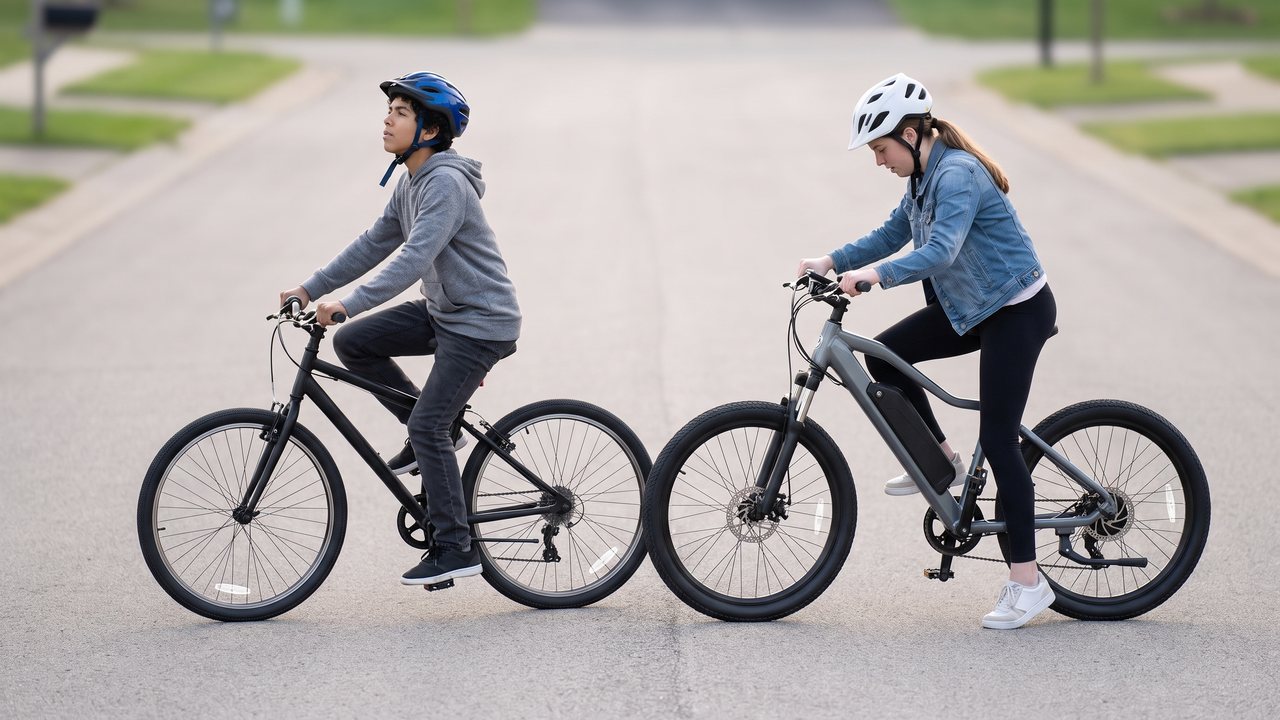
A gap in the traffic is about to appear. One of those two is already moving when it does. The other one is looking down.
2The idea
A stop is a sequence, not an event
The safe-routes curriculum writes it as three steps: put the pedals at twelve and six, take the foot off the one at twelve, straddle the machine. The cycling school gives the same thing in body terms — slide forward off the saddle, put your weight on one foot, lean the machine towards the other foot so it is outboard of the pedal, and set that foot down just as the machine stops.
Both are describing one idea. You decide which foot is going down before you get there, and the other leg stays exactly where it is, doing the work. A stop where you have not decided is the one where both feet go looking for the ground at once.
3The idea
Why the foot comes down from twelve
The foot at six is holding you up. It has your weight on it and a crank underneath it, and it is the last thing you want to move. The foot at twelve has nothing on it and the shortest distance to travel. The free foot reaches for the ground and the loaded foot stays put.
The standard puts a criterion either side of that: apply the brakes to bring the cycle to a smooth stop, and apply the brakes before getting off. A machine this heavy will roll off a kerb on its own while your leg is still in the air.
4Say it
The word you say out loud
Say it loud enough to be heard behind you
“Stopping.”
This is not something we made up. The classroom curriculum it comes from marks students on it: verbal confirmation, the word stopping, with a hand signal where a hand is free. Say it in an empty lot with nobody there and it will be there on a road with somebody behind you.
5The idea
The reset, which is the whole point of the lesson
While you are stopped, use the foot that is not on the ground to lift a pedal back to two o’clock for your next start. Do it before your hands come off the bars, so it belongs to stopping rather than to something you have to remember.
A rider who stops with the pedal already at two moves off the moment a gap appears. A rider who does not has to fumble first, and the fumble happens in the one place you least want to spend two spare seconds, which is out in the middle of a junction.
6Decide
You stop at a junction. Twenty seconds later a gap appears.
Pick one to carry on.
7Your turn
The whole loop
Stop, reset, go
A machine on a chalk line. Run a stop: choose which foot goes down, where the pedals end up, when the brakes come on, and whether you reset. Then a gap appears on a timer. The card shows how long you took to get moving, and lets you run it again having reset the pedal.
Run it once without the reset and once with, and look at the two numbers rather than taking our word for it.
8Find them
Which of these belong to a controlled stop?
Tap the ones that count.
Find all 4.
9Do it
Before you leave this page
Chalk a line in your space and do ten stops on it with somebody watching. They tick a stop only if you said stopping out loud, one foot came down from twelve while the other stayed on its pedal, and the pedal was back at two before your hands left the bars. Then do five more leading with your other foot.
Tick it when you have done it.
Lesson done.
Squeeze it down, weight on one foot, the other comes down from twelve. Then put the pedal back to two, every single time.
Next lesson: Riding a straight line, which is harder than it sounds