
Badge Kids › Road Badge › Section 3 › Lesson 3.2
All courses›Road Badge›Section 3
Setting off from a standstill
Set off from a standstill with the pedal at two o'clock, the brakes held until you are on, and a look ahead and behind first, in a straight line and without a wobble.
1Watch
The first four feet
The first four feet
A rider pushes off from a standstill with the pedal hanging at the bottom of its stroke, scoots twice, and the front wheel wanders sideways; the frame freezes with the wheel crossing a chalk line.
16 secondsNobody in that shot did anything reckless. The whole wobble was settled before the machine moved at all, by where one pedal happened to be.
2The idea
Two different programmes, the same clock position
A state safe-routes-to-school curriculum and an adult cycling school both teach this start, and both give the same position on a clock face. Raise the starting pedal to two o’clock. The cycling school calls it the power position and says that with the technique in place a start becomes a non-event — no bike handling required, just steps in order.
That is a strong claim and it is the right one. Almost everything that goes wrong in the first few feet of a ride is not balance. It is a rider trying to get moving off a pedal with nothing left in its stroke.
3The idea
Why two o'clock and nowhere else
A pedal at two is near the top of its circle with the whole downstroke still ahead of it. Stand on it and your weight goes into moving the machine. A pedal at the bottom has nowhere left to go, so instead of driving you forward it turns your start into a scoot, and the scoot is where the wandering comes from.
On a heavy machine this matters more than it did on the bike you learned on. There is more mass to get going, so a weak first push means longer spent at the speed where any machine is least stable, which is walking pace.
4Look
Two o'clock, and six
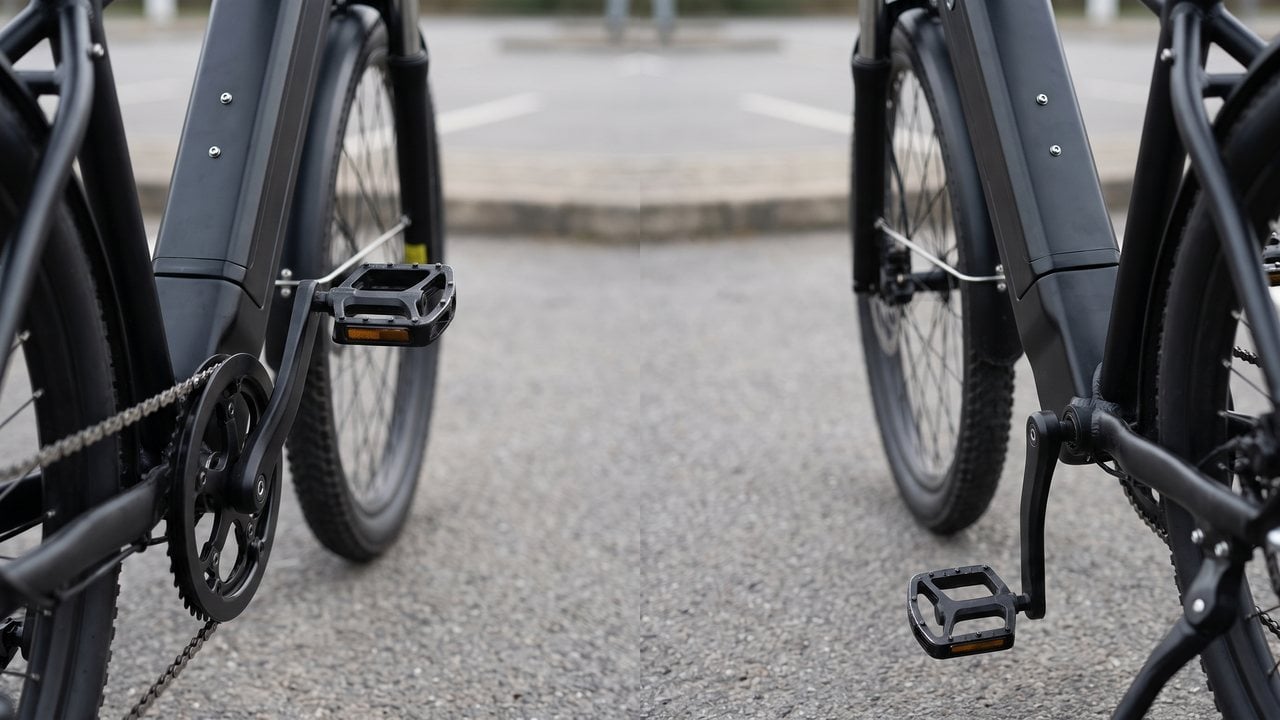
One of those you can stand on. The other one is a footrest. Moving a pedal from the second picture to the first takes about half a second and you can do it with your toe.
5The idea
The five things, in order
Brakes on before you get on. The training standard writes that as a criterion of its own, because a machine that rolls while you swing a leg over is a machine you are chasing.
Straddle it, one foot on the ground.
Bring the other pedal up to two.
Look ahead, then behind over each shoulder.
Step down onto the pedal, push, slide back onto the saddle.
The fourth is the one riders drop first, and it is written into the standard too: look for hazards ahead and behind before setting off. In an empty lot it feels pointless. That is exactly why you build it here, where there is nothing to find.
6Decide
You are stopped at the end of the lot and the pedal is hanging at the bottom.
Pick one to carry on.
7Build it
Build the start
The five steps
Five shuffled cards: brakes on, straddle it, pedal to two, look ahead and behind, stand on it. Drag them into order. Get it wrong and the card plays what happens – the machine rolls away from you, the wobble, or a start into something you never looked at.
Two of the wrong orders you can build look completely reasonable and still put the machine in motion before you are on it.
8Find them
Which of these belong in a start?
Tap the ones that count.
Find all 4.
9Say it
Four words, in order
Say it out loud as you get on
“Brakes. Two o'clock. Look. Go.”
Say it on every start for a fortnight. The order is the part that has to go automatic, because in a month you will be doing this at a junction with something coming.
10Do it
Before you leave this page
In your space, do ten starts from a standstill with somebody watching, five leading with each foot. They tick a start only if the pedal was at two before you moved, the brakes were held until you were astride it, you looked ahead and behind, and the front wheel stayed inside a chalk line for the first ten feet.
Tick it when you have done it.
Lesson done.
Brakes on. Straddle it. Pedal to two. Look ahead and behind. Then stand on it.
Next lesson: The stop, and the pedal you leave behind