
Badge Kids › Road Badge › Section 2 › Lesson 2.6
All courses›Road Badge›Section 2
The battery and the charger
Charge and store the battery to the five rules, name the six warning signs, and say what you do if one of them shows up.
1Look
The worst place in the house to charge it
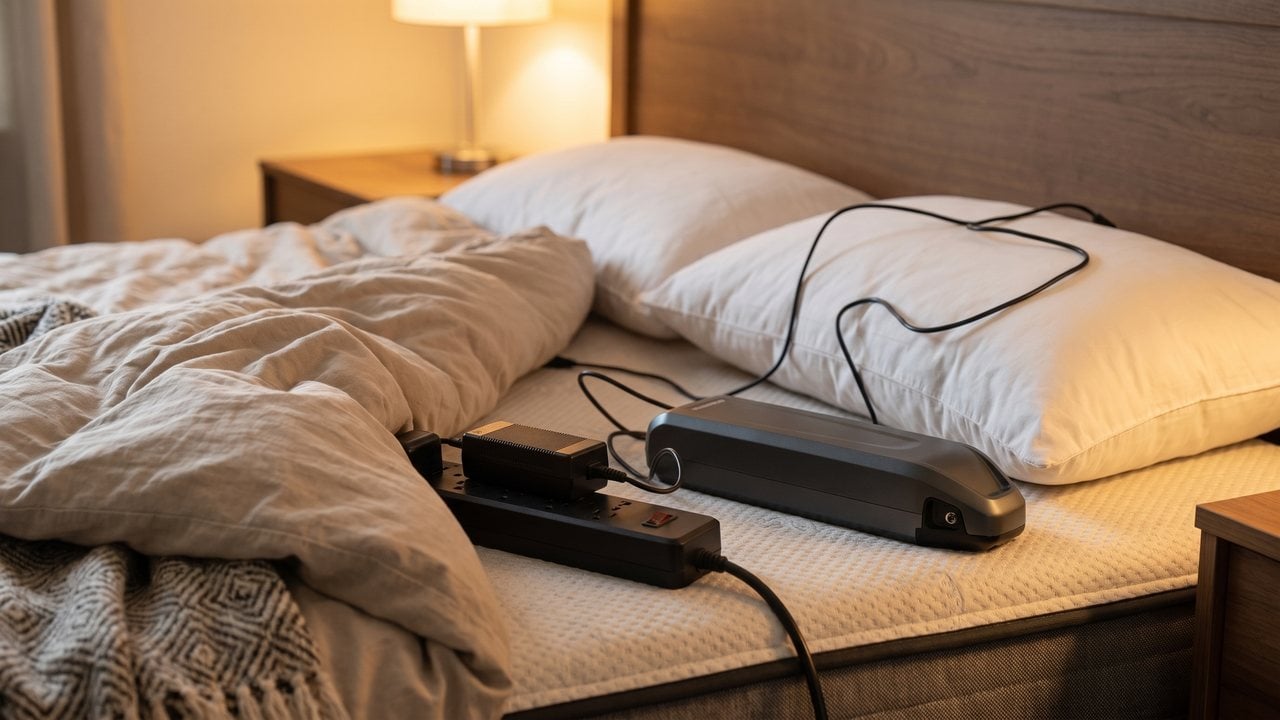
At least three separate things are wrong in that picture. By the end of this lesson you will be able to name all of them without being told.
2The idea
Why a riding course is talking about a plug
Everything else in this badge is about what happens to you on a road. This lesson is about what happens to a house at night, and none of the people it happens to are riding at the time.
We did not write any of what follows. It is the fire code body and the federal fire service, and where they overlap they say almost exactly the same thing. That is unusual enough that it is worth taking the whole list at face value.
3The idea
The five rules
Only the charger and battery that came with the machine. Never a substitute, never an extension lead, never a multi-plug adapter.
Unplug it when it is full. Not overnight, not left on for too long.
Never in a doorway or a hallway you would escape through, and away from anything that burns.
Not in extreme heat or cold, especially while charging.
And the fifth: if it does catch fire, do not try to put it out. Get everybody out, then call 911 from outside. A lithium battery fire is not a fire you fight with anything you have in the house, and it makes smoke that is the thing that actually hurts people.
4Build it
Put it somewhere
Where does it charge
A cutaway house with a hallway, a bedroom, a garage, a kitchen worktop, a back step and a cupboard under the stairs. Drag the charging machine into a room, then choose wall socket or extension lead. The card lists which of the five rules you have just kept and which you have broken.
Try the room it charges in now, first. That is the one this lesson is actually about.
5Decide
Your charger has died. There is an unbranded one on a marketplace app, cheap, arriving tomorrow.
Pick one to carry on.
6The idea
Six signs, and then it is finished
Stop using the battery if you see any one of these.
An unusual smell.
A change in colour.
Too much heat.
A change in shape — swelling or bulging.
Leaking, or smoke.
It stops holding a charge.
The fire service also says to look for cracking, bulging or leaking as a routine thing rather than only when something feels wrong, which is why it went into your pre-ride check in the last lesson. One sign is enough. You do not need two, and you do not investigate it.
7Say it
The sentence for the moment it happens
Say it out loud, in your normal voice
“Nobody touch it. Everyone outside, and I'm calling 911.”
You do not carry it anywhere, you do not put it in a bucket, and you do not go back for the machine. Get people out, then call from outside, then do what they tell you.
8Find them
Which of these mean stop using the battery?
Tap the ones that count.
Find all 5.
9The idea
Two more, and then you know the whole list
A dead battery does not go in the bin. Lithium cells are not household rubbish anywhere in either country. They go to a battery recycling point, or your local waste service will tell you where. A crushed cell in a bin lorry is how some of these fires start.
And repairs are a qualified professional, always. That is written flat, with no exceptions in it. There is no part of a battery, a motor or the wiring that is a job for you, a friend, or a video. Everything else on this machine you can learn to do.
10Do it
Before you leave this page
Go and look at where your battery charges tonight. Its own charger, straight into a wall socket, not in a bedroom, not across the way out of the house, nothing burnable next to it. Move it if it is not, and tell whoever else lives there where it is now.
Tick it when you have done it.
Lesson done.
Its own charger, straight into the wall, unplugged when full, never across the way out. Six signs and it is finished.
Take the Section check