
Badge Kids › Road Badge › Section 1 › Lesson 1.3
All courses›Road Badge›Section 1
The phone, the music and your ears
Set the route and the music before the wheels move, ride with the phone away and at least one ear open, and stop with both feet down before you touch it.
1Watch
The buzz at the top of the hill
The buzz at the top of the hill
A rider freewheels down a residential hill with both hands on the bars; a phone lights up in a jacket pocket and the frame freezes as one hand leaves the bar and the first driveway comes into shot.
18 secondsThat is a competent rider on a road they know. Everything they have ever learned about driveways is still in their head and none of it is being used.
2The idea
The instruction, in the words it is written in
The e-bike safety course written for adults gives it as one line with no argument attached: do not ride when impaired or distracted, and put away your phone and earbuds. A state safe-routes-to-school programme says what the cost is: distractions, such as phones, music and fatigue, delay your response time.
Look at what is on that list next to the phone. Music counts. Being tired counts. It is not a rule about screens. It is a rule about how much of you is available for the road, and there is more than one way to spend that.
3The idea
Response time is not time. It is distance.
A stop has two parts. The first is the ground you cover between seeing the problem and your hands actually squeezing. The second is the ground you cover with the brakes on. Only the second one is about brakes at all.
Everything on the distraction list makes the first part longer, and the machine keeps travelling the whole time. That is why a delayed response is not an abstract thing. It comes out of the far end as metres of road, added on before the brakes have done anything.
4Your turn
Watch the first bar grow
The two bars
A rider approaching a marked crossing, with two bars underneath: the ground covered deciding, and the ground covered braking. Toggle a message arriving, one earbud, both earbuds, and a tired rider. The braking bar never moves. The deciding bar does, and the crossing stays where it is.
Turn them on one at a time, then all together, and watch where the front wheel ends up relative to the crossing.
5Decide
Your phone buzzes twice in your pocket, halfway along a road you know well.
Pick one to carry on.
6The idea
Ears are not a spare sense on a road
A car coming up behind you. A driver braking hard. Somebody shouting. A dog off a lead. Most of those reach you as sound several seconds before they reach you as anything you could have seen, and a rider with both ears full has traded that away for a playlist.
The household rule paediatricians recommend to families is short: no earbuds, and no riding in traffic or at night. You can have the music at both ends of the ride. The middle of it is the part where your ears are doing a job.
7Say it
The line for the buzz in your pocket
Say it out loud, in your normal voice
“It can wait until I have both feet down.”
Use it the first time the phone goes on your next ride. Having the sentence ready turns it into something you do rather than something you decide, and decisions taken in traffic are the expensive kind.
8Find them
Which of these delay your response?
Tap the ones that count.
Find all 4.
9Look
Three places a phone can live
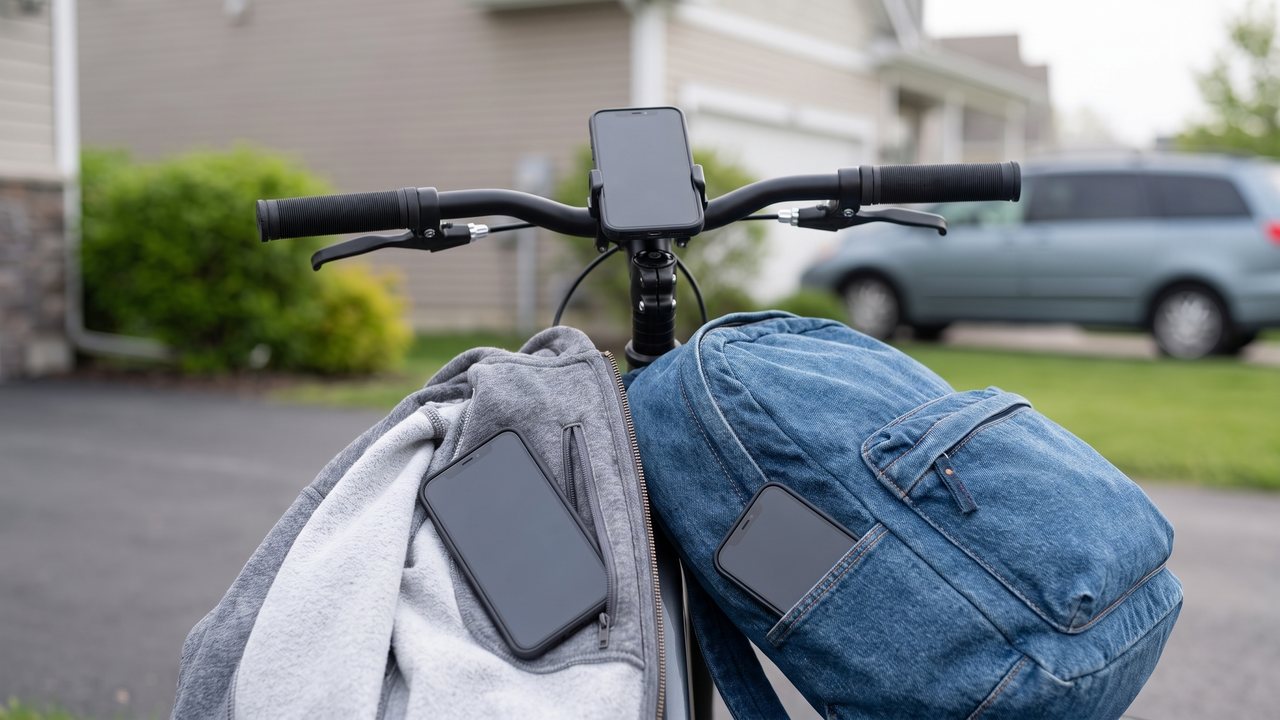
Two of those are away. The third one is not away, it is just parked in front of you, which is the whole trick of it.
10Do it
Before you leave this page
Go to your machine and decide where the phone actually lives while you ride – a zipped pocket or a closed bag, somewhere you cannot get at it one-handed. Put it there now, and take the earbuds out of whichever pocket they live in so you do not find them on the way.
Tick it when you have done it.
Lesson done.
Phone away, ears open, sorted before the wheels move. Distraction is not lost time, it is ground you already covered.
Next lesson: Why this is harder at fourteen than at forty