
Badge Kids › Road Badge › Section 5 › Lesson 5.6
All courses›Road Badge›Section 5
Junctions, both left turns, and the strategy that comes last
Make a left turn by either lawful method and say why you chose it, and run the four-step hazard strategy at a real junction.
1Look
Two ways through the same junction
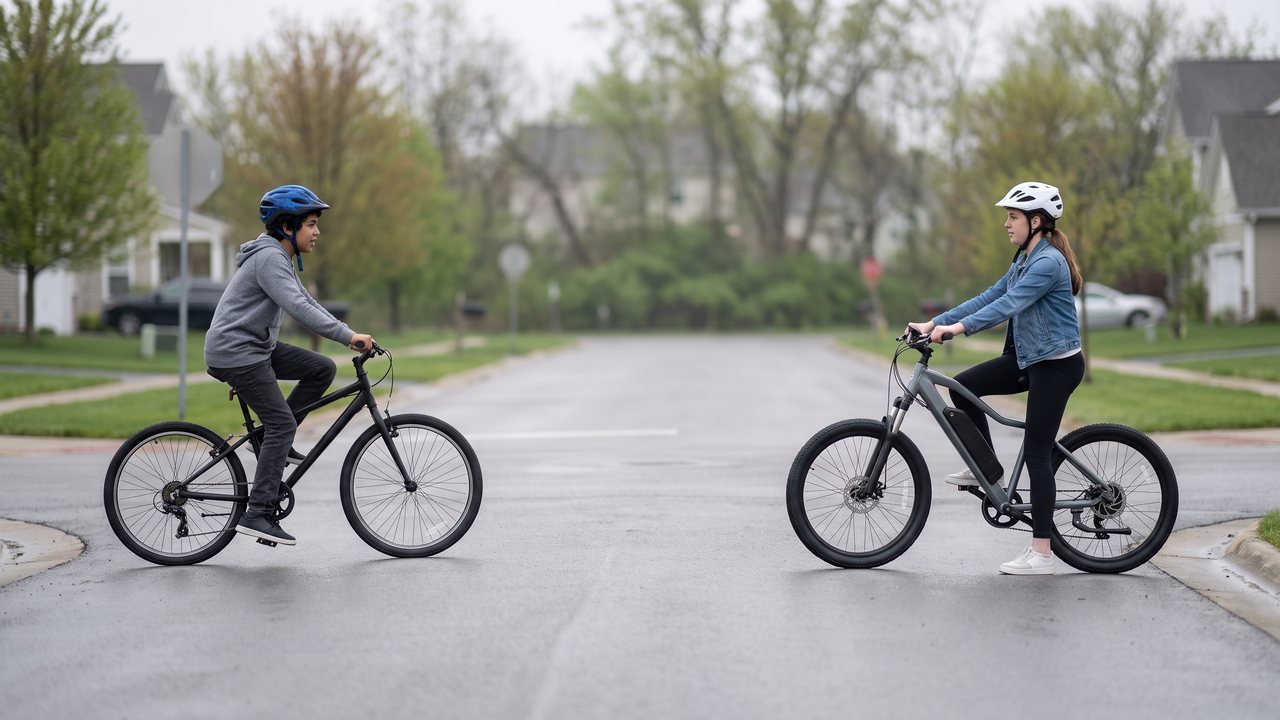
Two lines, one junction, one rider. Both of those are turns you are allowed to make, and choosing the second one is not the timid answer.
2The idea
Junctions are where it happens, and the instinct is backwards
The national cycling body says it plainly: most crashes between riders and drivers happen at junctions, and the countermeasure it names first is not speed or nerve. It is position — being visible and being predictable about where you are going.
And here is the reversal you have to drill. The approach to a junction is where you leave the edge, not where you hug it. The positioning standard lists junctions in its primary-position situations, and state guidance says the same thing from the other end: avoid squeezing by on the right at junctions. Your instinct will be to move right. Move out instead.
3The idea
Two left turns, and both of them are real
The vehicular left. Look behind, signal, move across into the correct lane in good time, and turn as a car would. It is quick, it is what drivers expect, and it needs a proper look, a signal, and a gap.
The two-stage left, also called the box turn. Stay right, go straight across to the far corner, stop, and then set off again on the new road when its signals or its traffic let you. No merging across moving traffic at any point. One state’s code writes both of these out as a choice a rider has, and some towns paint a bike turn box on the ground for exactly this.
4Build it
Draw both lefts
Pick your left
Four junctions, one at a time: a quiet crossroads, a wide four-lane road with a left-turn lane, a busy junction with a queue in every direction, and a T-junction with a painted turn box. Draw either left through each and the card plays it back, showing where you would have had to cross moving traffic and where you would not.
Draw the vehicular left through the busy one first. It is not that it cannot be done, it is that you can see exactly how much of it depends on the gap you get.
5Decide
A four-lane road, traffic moving steadily, and you want to turn left.
Pick one to carry on.
6The idea
The strategy, and it comes last on purpose
Adult motorcycle training names its perceptual strategy SEE — Search, Evaluate, Execute, calls it the core of a personal safe-riding strategy, and says it links decision-making with visual awareness. It puts SEE at sections seventeen to nineteen of a twenty-section course. The cycle training standard uses four steps and adds one the motorcyclists leave implied: keep looking ahead and behind, close in and far out; anticipate what could happen; judge which of them matters most and prioritise your response; then respond.
Notice where both of them put it: at the end. Not because it is optional but because you cannot spend attention on the road while you are still spending it on the pedal. Everything in the four badges before this one was buying you the attention that this lesson spends.
7Look
Four things at once
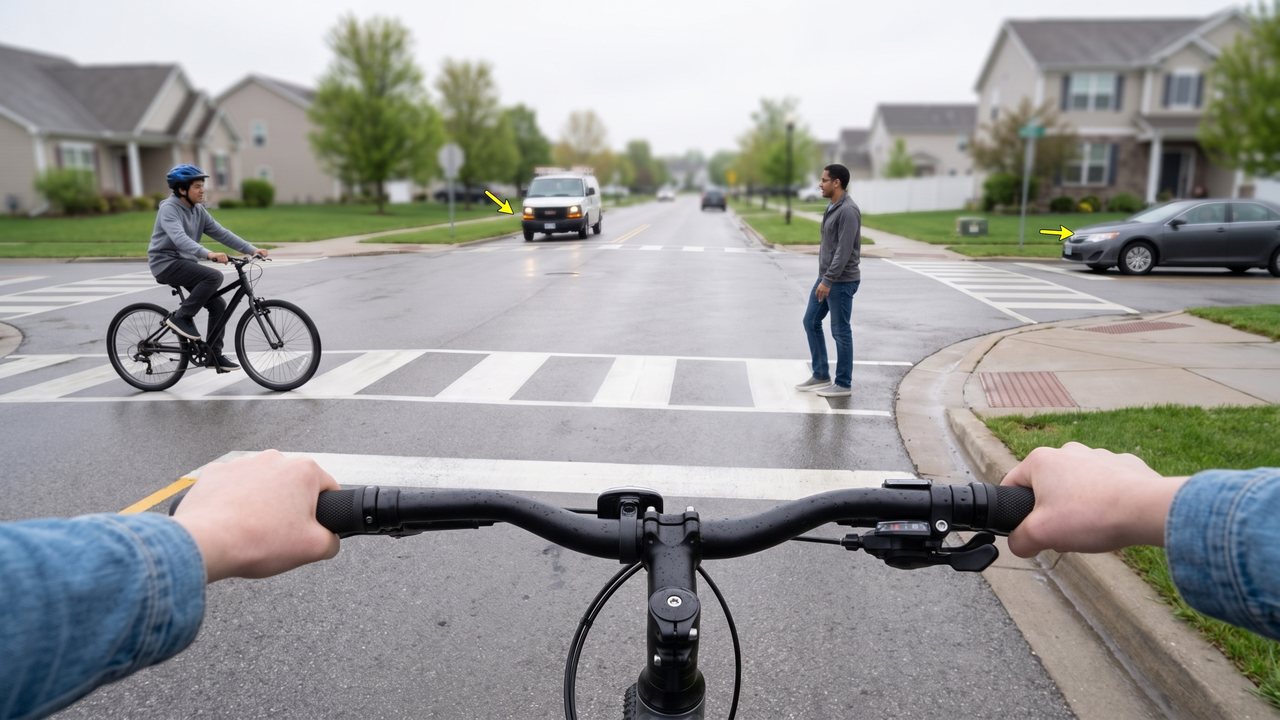
All four are real and none of them are emergencies yet. The question the strategy asks is not what can you see, it is which one of those do you deal with first.
8Find them
Which of these belong to the four-step strategy?
Tap the ones that count.
Find all 4.
9Say it
Three words from the motorcycle course
Say it out loud before every junction on your next ride
“Search. Evaluate. Execute.”
Say it approaching junctions until it stops being three words and becomes the order your eyes and your hands already work in. It is the same three steps whether you are on this machine or in a car in four years.
10Do it
Before you leave this page
Stand on the pavement at a real junction with an adult for two minutes, not riding. Every time a gap comes, say out loud what you can see, what each thing could do next, and which one you would deal with first. Then walk both left turns through that junction on foot and say which one you would use there and why.
Tick it when you have done it.
Lesson done.
The approach to a junction is where you leave the edge, not where you hug it. Two lawful lefts, and you pick.
Take the Section checkSection 5 · You Are Traffic
5.1You are traffic, and here is the sentence that says so5.2The two positions, and both of them have names5.3Control and release, which has the give-back in the name5.4The rule everybody quotes in half5.5Four feet, and whose offence a dooring is5.6Junctions, both left turns, and the strategy that comes last★Section check