
Badge Kids › Road Badge › Section 3 › Lesson 3.4
All courses›Road Badge›Section 3
Riding a straight line, which is harder than it sounds
Ride a corridor one to two feet wide and twenty to thirty feet long without touching either edge, pedal steadily for a full minute, and keep your fingers covering the brake levers the whole way.
1Watch
Thirty feet of chalk
Thirty feet of chalk
Two chalk lines about a foot and a half apart run away across empty tarmac; a rider enters at one end and the frame freezes with the front wheel just crossing the left-hand line halfway down.
15 secondsNo traffic and nothing dramatic. A drift of about eight inches over thirty feet, which on a road is the difference between your bit of it and somebody else’s.
2The idea
The cheapest good drill in the course
The governing body for cycle racing describes it in one line: two rows of markers one to two feet apart, twenty to thirty feet long, and you ride between them. Half tennis balls, chalk, anything that will not hurt a wheel if you hit it.
It is worth asking why something that small gets taught by everybody. A corridor turns wandering into a thing you can see. You either stayed inside it or you did not, and there is no arguing with a chalk line. Nothing else in this badge gives you that clean an answer about your own riding.
3The idea
What the standard actually asks for
The national cycle training standard puts four criteria next to each other and they are all about the same minute of riding.
Ride along independently for at least a minute.
Pedal steadily, using gears if it has them.
Control my speed.
Cover the brake levers while pedalling.
That last one has a criterion of its own and it is easy to skim past. Covering the levers means your fingers are already resting on them, so the only thing left to do is squeeze. It takes the reaching-for-the-lever part out of every stop you will ever make.
4Look
Where you are looking
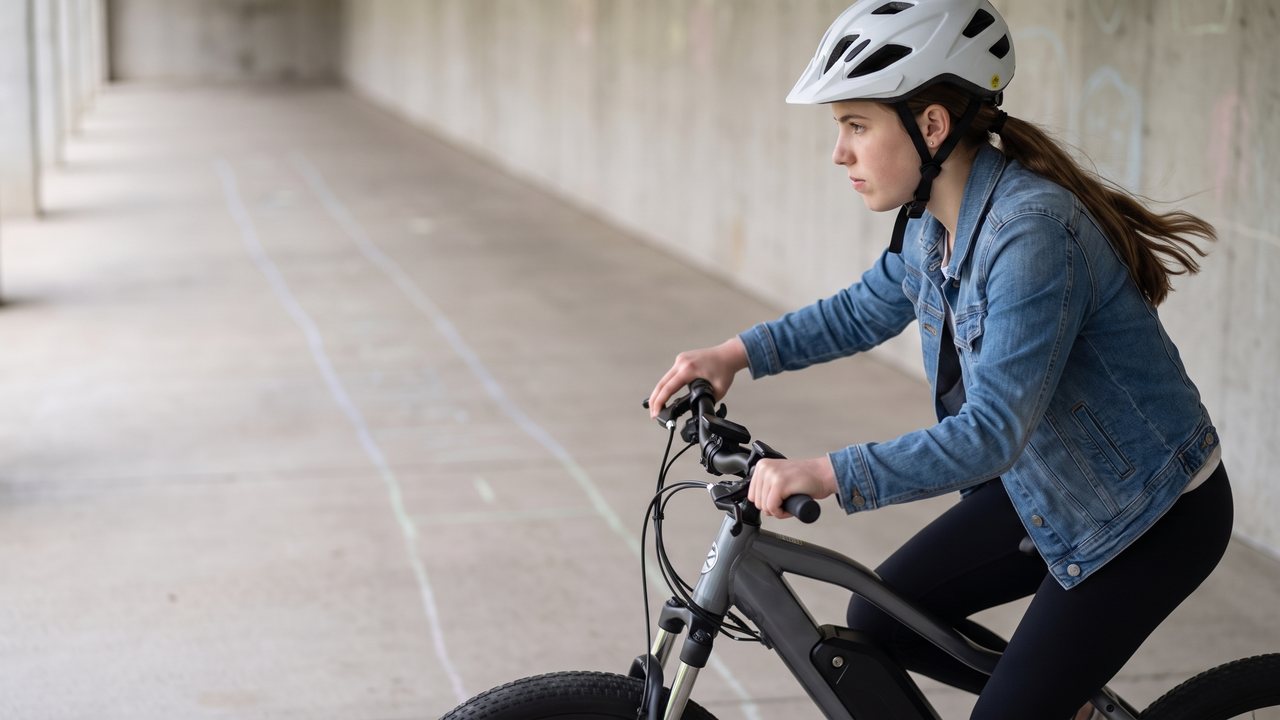
The one watching the front wheel is the one who wanders. You go where you look, which is a fact this course is going to use twice more before it is finished.
5Decide
Halfway down the corridor you feel yourself drifting left.
Pick one to carry on.
6The idea
Slow is the hard part, and there is a reason
A machine is more stable the faster it goes, so the wobbliest parts of every ride you take are the first few feet and the last few. The corridor is deliberately run at the speed where holding a line is hardest, which is why it transfers straight to junctions, queues, and setting off next to a kerb.
The racing body’s own coaching note for this is one line and worth stealing: maintain pedal pressure. Keep some drive going through the machine rather than freewheeling and hoping it settles by itself.
7Your turn
Four runs, one corridor
The corridor
A chalk corridor seen from above with a rider going down it, and two things you can toggle: eyes at the far end or eyes on the front wheel, and pedalling steadily or coasting. The line the wheel draws stays on screen after each run so you can compare all four attempts.
Do all four combinations. The two that keep you inside the lines are the two the coaching notes tell you to use, and now you have watched why.
8Find them
Which of these are part of holding a line?
Tap the ones that count.
Find all 4.
9Say it
Three words for the corridor
Say it out loud before you set off down it
“Far end. Fingers on.”
Two instructions, and they are the two that get dropped: look where you are going rather than at the machine, and have your fingers already on the levers rather than somewhere near them.
10Do it
Before you leave this page
Chalk two lines about a foot and a half apart and thirty feet long, and ride the corridor five times with somebody watching. They tick a run only if you touched neither line, your fingers were on the levers the whole way, and your head stayed up. Then ride a steady minute around the space without stopping.
Tick it when you have done it.
Lesson done.
A line you can hold is the thing everything else is built on. Eyes at the far end, fingers already on the levers.
Next lesson: Slow control: the weave and the box