
Badge Kids › Home Alone Ready › Section 1 › Lesson 1.3
All courses›Home Alone Ready›Section 1
Head up
Walk home with your phone in your pocket, one ear open, looking at faces.
1Watch
Two walks, side by side
Split screen
Same street, same kid. Left: phone in hand, both earbuds in. Right: phone in pocket, one ear open. A car starts reversing out of a driveway ahead of both of them and the film stops.
26 secondsWatch which one is about to notice.
2The idea
This is not about your phone
Nobody is telling you not to have a phone. It is how you tell a parent you are on the way, and it is what you would use if something went wrong. Have it. Just have it in your pocket.
A phone in your hand takes your eyes, your ears and your attention all at once. And everybody around you can see that it has. A kid with their head down has told the whole street that they are not looking.
3The idea
The three parts of head up
1. Phone in the pocket, not the hand.
2. One earbud out, or none. The road-side ear is the open one.
3. Look at faces as you pass. Not staring. Just up.
Two things happen. You see the car reversing, the gap between parked cars, the person sitting in one. And people notice being noticed. A kid who is looking around is a bad target and a good pedestrian, both at once, for free.
4Look
Looking at faces
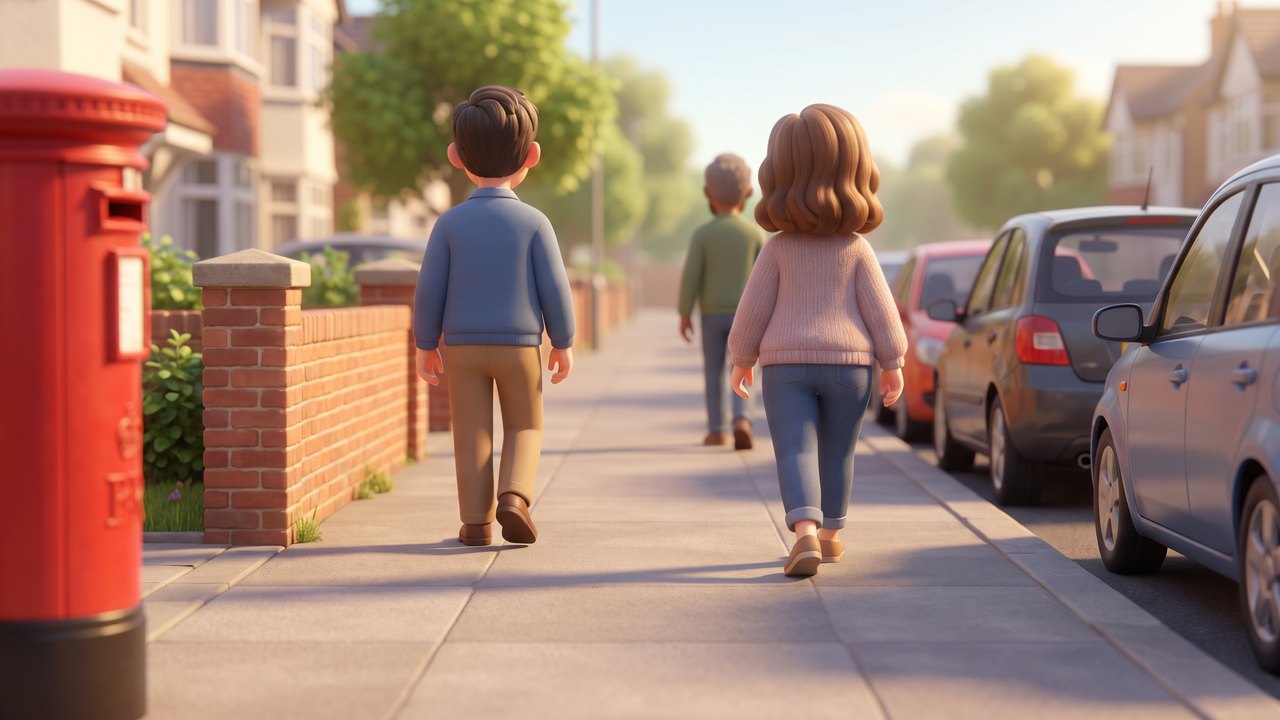
You do not stare at anyone. You just look up. People notice being noticed. That is nearly the whole skill.
5Decide
What is the actual reason to keep it in your pocket?
Pick one to carry on.
6The idea
Leo gets a message on the way home
The phone buzzes. Leo stops, puts his back to the shop wall, reads it, replies, pocket, walks on. The whole thing takes twenty seconds and he saw the pavement the entire time. The phone comes out when you have stopped, and goes back before you move.
Music is the same idea. One earbud in, the road-side one out. Or none. You can hear a car before you can see it, but only with an ear that is open. A song can wait the length of a street.
7Try it
The same walk, twice
Head down, head up
Two versions of the same walk play side by side. Pause the head-up one and tap everything it saw that the head-down one missed. There are five.
Nothing dramatic happens in either film. That is the point. Head up is not for the dramatic day. It is for every day, so that the dramatic day never gets going.
8Find them
On the walk home, which of these would you actually miss with your head down?
Tap the ones that count.
Find all 4.
9Do it
Before you leave this page
Walk to the end of your street and back with your phone in your pocket the whole way. Count how many people you actually looked at.
Tick it when you have done it.
Section 1 · Getting Home
1.1The route you agreed1.2The shortcut you walk past1.3Head up1.4The key★Section check