
Badge Kids › Road Badge › Section 6 › Lesson 6.4
All courses›Road Badge›Section 6
Lights, and the half of it everybody has backwards
Set your machine up with a front lamp and a rear light and say which of the two the law is usually strict about, and name when lights go on.
1Watch
A red light nobody in front can see
The red light nobody in front can see
A rider comes down a road at dusk with a red light blinking clearly on the back of the machine and nothing at all on the front; a car waiting at a side road ahead begins to pull out, and the frame freezes with the car halfway across.
18 secondsThat rider would tell you they had lights on, and they would be half right. The half that was missing is the half pointed at the person who had to decide.
2The idea
What the dark actually costs, said carefully
The national figures for one recent year: 1,105 riders killed, and more of those happened in the dark, 51 per cent, than in daylight, 45 per cent, or dusk or dawn. Across five years about half were in dark conditions, and the hours from six in the evening to eleven at night account for more than other times of day.
Two honest notes before you carry that around. Those deaths are mostly adults — the average age is forty-eight — so it describes the environment rather than the risk to somebody your age. And it is a count, not a rate: nobody divided it by how much riding happens after dark. It is still the right number. It is just not proof on its own.
3The idea
The asymmetry, which is the thing to actually remember
Lighting rules are written in two halves and the halves are not the same. Here is one state’s code as a worked example: at night, a lamp on the front emitting a white light visible from at least 500 feet, and on the rear a red reflector visible from 100 to 600 feet, with a red light allowed instead of the reflector.
Read that again, because it is the opposite of what everybody assumes. The hard requirement is the front. The back can be satisfied by a piece of plastic that does nothing until somebody else’s headlights hit it. A rider with a rear blinky and no front lamp is the one who is actually breaking the rule.
4Look
Two ends, two jobs
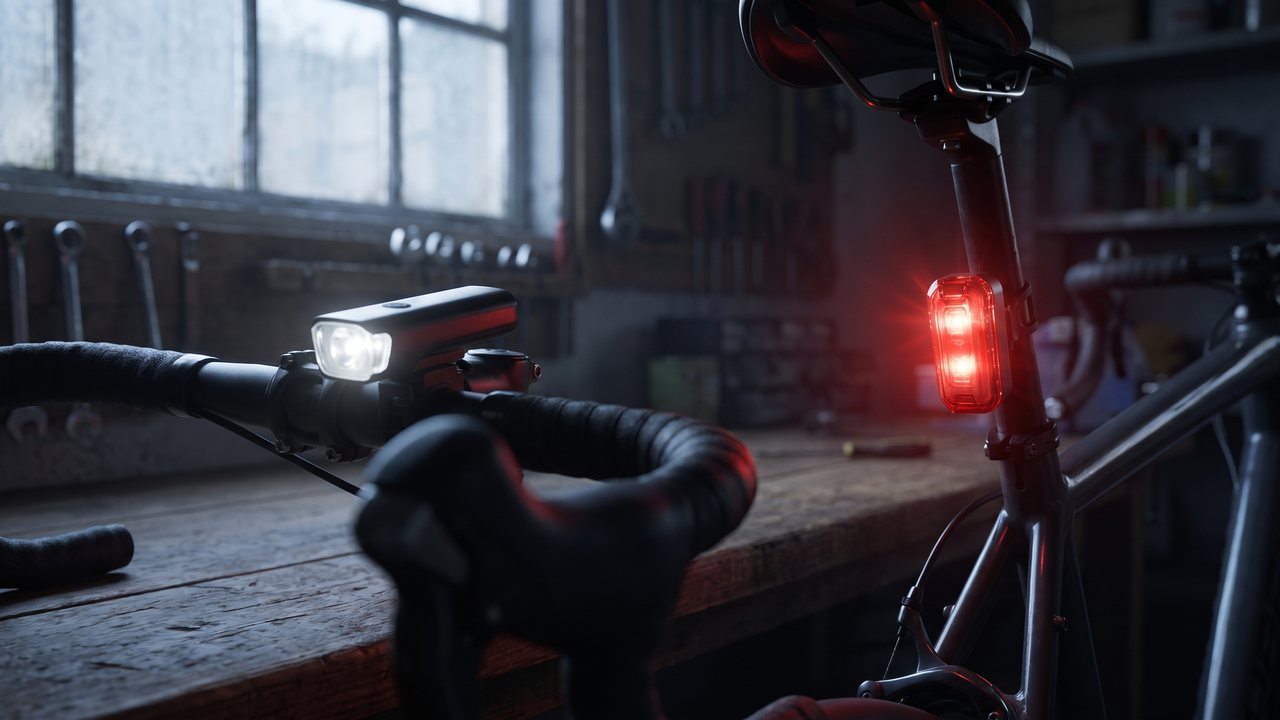
One of those is doing a job on its own and one of them is waiting for somebody else to do the job for it. Both are useful. Only one of them works before a driver has already pointed their headlights at you.
5The idea
Why every rider gets this backwards
Because the blinky is the one you can see. You stand behind the machine, you watch it flash, and something in your head files that as having lights. You cannot see your own front lamp doing its job, because the job happens out in front of you and it is being done for somebody else.
The person it is for is the driver at the side road in that film, deciding whether the gap is empty. They are looking for a light coming towards them. If there is not one, the gap is empty, and they are not being careless when they pull into it.
6Decide
You are leaving a friend's at dusk. You have a rear blinky and no front light.
Pick one to carry on.
7The idea
The standard asks for more than the law, and when to switch them on
The national cycling body teaches a front white light, a red rear light, and reflectors, whenever visibility is poor. That is more than the minimum most codes ask for, and it is the version to actually own: both ends lit, plus the reflectors that came on the machine.
When? Sunset to sunrise, and any time you cannot see well — rain, fog, heavy cloud, a long underpass. That last part is advice rather than a quoted rule, because codes define night differently and some do not define it clearly at all. Yours may be worded its own way, and finding it is the next lesson.
8Find them
Which of these are true about lights?
Tap the ones that count.
Find all 4.
9Say it
Which end first
Say it out loud while you are setting the machine up
“Front lamp first. The blinky is the easy half.”
Say it every time you set the lights, because the front one is the one that gets left on a desk on charge. It is also the only one of the two that is doing anything before somebody has already found you.
10Do it
Before you leave this page
At dusk, set the machine up on the drive with everything you have switched on. Walk thirty paces away and look back at it from the front, then from the back, and say out loud which end you could pick out first and from how far. Then check the front lamp is on the machine and charged, not on a desk indoors.
Tick it when you have done it.
Lesson done.
Front lamp first. The blinky on the back is the easy half and the one you can see yourself.
Next lesson: How to find your own rule, which is a skill