
Badge Kids › Road Badge › Section 6 › Lesson 6.3
All courses›Road Badge›Section 6
The rule changes at a line you cannot see
Name the towns and path districts your usual ride crosses, and say what you do about the ones whose rules you do not know.
1Look
Nothing changes except everything
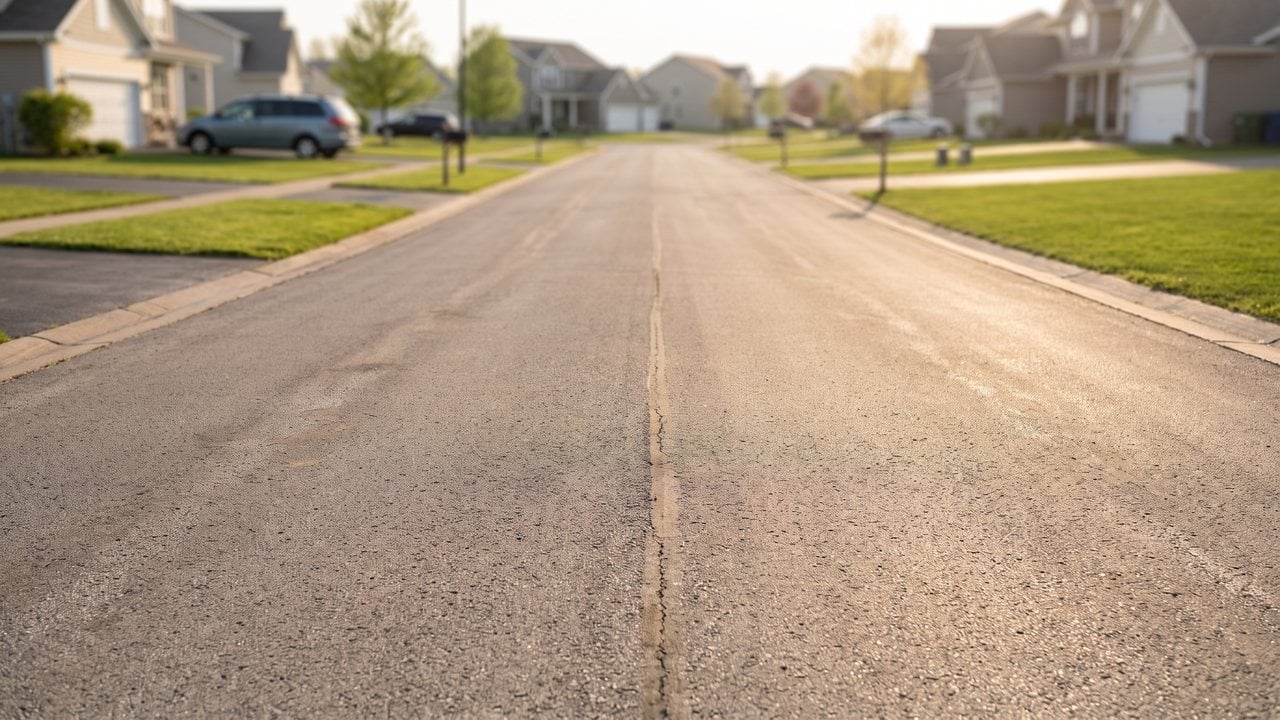
Same road, same width, same speed limit. On one side of that sign a rider your age may be entirely legal and on the other side they may not be, and there is nothing painted on the road to say so.
2The idea
What the patchwork actually looks like, from one real cluster
In one state, in one group of neighbouring suburbs, all in the same year: one village set a minimum age of sixteen. The next one regulated by speed band rather than by class, and let you out of the age rule by passing a safety quiz. Another said under-sixteens could ride the same machine as long as the motor stayed off. Two of them required helmets where the state did not. One of them allowed e-scooters on sidewalks.
Those are neighbours. Not a coast-to-coast comparison — towns you could ride between in half an hour. That is not an unusual cluster; that is what the map looks like nearly everywhere until a state or province writes one rule over the top of it.
3The idea
And paths are a separate map again
A path is owned by somebody — a park district, a forest preserve, a county, a conservation authority — and each of them sets its own rule for its own paths. On adjacent trails in one area right now: the fastest e-bike class is allowed on one county’s trails, prohibited by the forest preserve district next door, and prohibited again on the neighbouring city’s own multi-use paths.
So a single ride can cross three different rules about one machine. And where a state writes one rule for sidewalks and ages, path authorities usually keep their power anyway. Where you live, paths and trails are set by whoever owns the path — and the sign at the trailhead is still the thing standing in front of you.
4Build it
Ride it across three lines
Three towns, one ride
A map with a route from home to a friend's house that crosses two town lines and one path district. Ride it a segment at a time. At each boundary, choose whether to change what you are doing. The card shows what the rule on each segment turned out to be, and what a rider who never changed anything would have done wrong and where.
Run it once without changing anything at all, which is what nearly every real rider does, and see how many segments come back clean.
5The idea
Four things a rider actually does about it
There is no legal duty to know every ordinance and nobody publishes an official method for this, so take these four as advice rather than as law.
Ride to the strictest rule you know of on the route. If any town on it bans sidewalks, do not use sidewalks anywhere on that ride.
Learn your own town properly, and the two or three you actually cross into. Not fifty. School, a friend’s, the pool.
A path has an owner, and the owner’s rule beats the town’s. The sign at the trailhead is the authority.
Where a state or province sets a floor, that floor is the same the whole way across it — but the paths still vary.
The first one does nearly all the work. It is the only strategy that is safe on the whole route without looking anything up, and it costs you almost nothing, because the strictest rule you know is usually just riding on the road properly.
6Decide
Your ride to a friend crosses two town lines, and you only know your own town's rule.
Pick one to carry on.
7The idea
The rule with an expiry date
One village currently allows e-scooters on its sidewalks. From the first of January 2027 a statewide rule forbids it, and that local permission simply stops being true — without the village doing anything, and without the sign changing.
So the date on what you read matters as much as the words. A page written eighteen months ago can be perfectly accurate about a rule that no longer exists. Whenever you find an answer, find its date in the same breath, and find out whether anything with a date on it is coming.
8Find them
Which of these can change at a town line?
Tap the ones that count.
Find all 4.
9Say it
The rule for a route with a line in it
Say it out loud before you set off
“Strictest rule on the route, the whole way.”
Say it at the start of any ride that leaves your own town. It converts a problem you cannot solve on the move into one decision you make in the driveway, which is where every decision in this course belongs.
10Do it
Before you leave this page
Get a map up with somebody and trace the ride you do most often. Count the town or village lines it crosses and name any path or preserve it uses. Then say out loud, for each one, whether you know its rule or do not. Pick the one you cross most and look that one up together tonight.
Tick it when you have done it.
Lesson done.
Ride to the strictest rule you know of on the route. A path has an owner, and the owner's rule beats the town's.
Next lesson: Lights, and the half of it everybody has backwards