
The rule quoted in half
Road Badge › You Are Traffic › The rule quoted in half

The rule quoted in half
Right-ish, unless. The unless is in the law.
1Half a sentence, highlighted
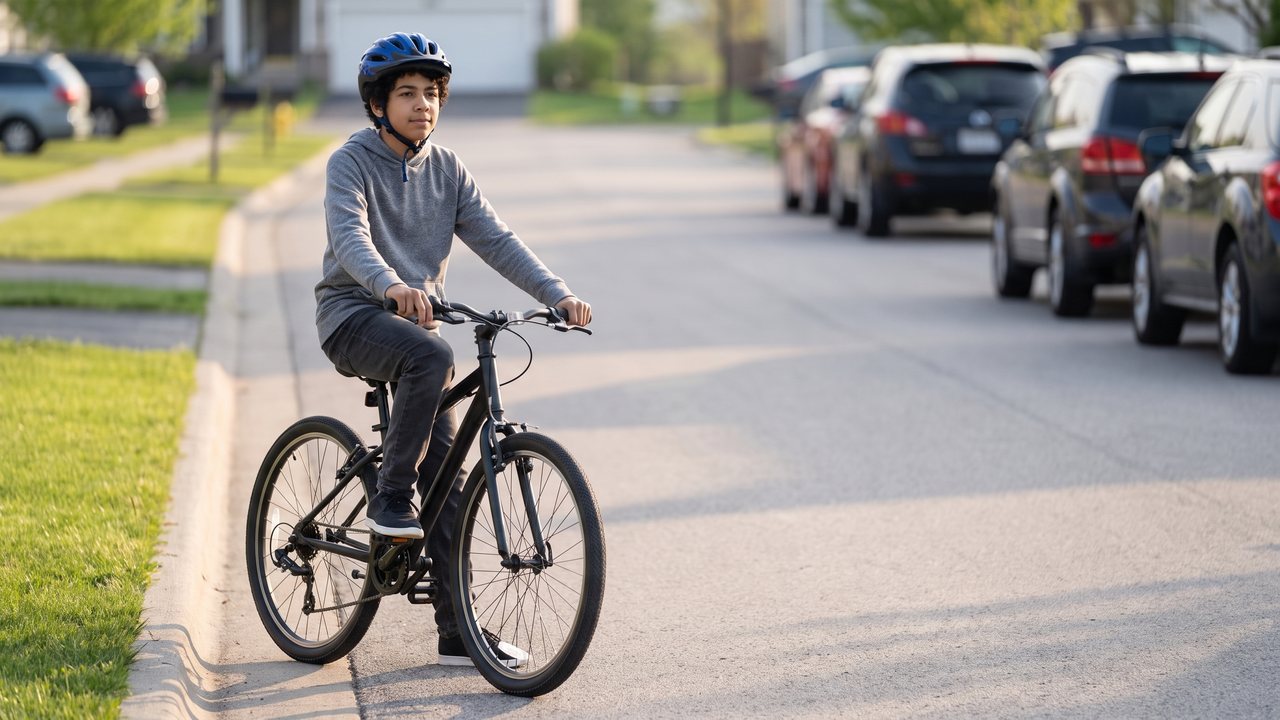
That is how the rule gets quoted, at you, in the street, by somebody who has read the yellow part. The gray part is longer and it is where you live.
2What people say, and what it says
What everybody quotes: ride as far right as practicable. What the statute in one real state actually says is that a rider going slower than the normal speed of traffic rides as close as practicable and safe to the right-hand curb or edge of the roadway — except under the following situations, and then it lists four of them.
The exceptions are not a loophole and they are not fine print. They are part of the same sentence, they are numbered, and the law spends more words on them than on the rule they modify.
3The four things it does not ask of you
The four, close to the words they are written in.
When overtaking and passing another bicycle or vehicle going the same way.
When preparing for a left turn, at an intersection or into a driveway.
When reasonably necessary to avoid conditions — and the list it gives includes fixed or moving objects, parked or moving vehicles, other bicycles, pedestrians, animals, surface hazards, and substandard width lanes.
When approaching a place where a right turn is allowed.
Read the third one twice. Parked vehicles are named in the law, which means riding wide of a parked car is not you bending the rule. It is you using one of the four things the rule is written around.
4Substandard width lane, which is the big one
The same statute defines it: a lane that is too narrow for a bicycle and a vehicle to travel safely side by side within the lane. That is the whole test, and it is about the lane, not about you.
One state’s own guidance puts a figure on it — under fourteen feet is too narrow to share. That is that state’s number and not automatically yours, but the idea travels: get out of the saddle and look at the lane, and if there is not room for a car and you in it side by side, the lane is the problem and the law already knows.
5Shrink the lane
A lane seen from above with a car and a rider side by side in it and a slider that changes the lane width. Drag it narrower and watch the gap between them close. The card marks the width where a state’s own guidance says the lane can no longer be shared, and shows what the rider is entitled to do from that point on.
Set it as narrow as it will go first and look at the picture, because that is what a squeeze past on a narrow street actually looks like drawn to scale.
6A neighbor says keep right at all times.
Pick one.
Right, and you can say it without an argument in it. The rule is right-ish unless, the unless is numbered, and parked cars and lanes too narrow to share are both on the list. You are not claiming an exemption. You are quoting the second half of a sentence they read the first half of.
Neither of those is where you want to end up. Apologizing for something the law explicitly protects trains you out of a position that keeps you alive. And treating the rule as if it does not apply throws away the part of it that is on your side, which is most of it.
7Why nearly every rider believes the opposite
The rule gets taught in half because half of it fits on a sign and the whole of it does not. So most riders, most parents and quite a few drivers genuinely believe the curb is a legal requirement, and ride accordingly.
On an ordinary street with cars parked down one side, at least one of the four exceptions is nearly always live. Your own state or province writes its own version of this rule, and the wording and the exceptions are not identical everywhere — so the job is to find yours and read the whole thing, which is a skill you get taught properly in the next section.
8Which of these are on the exceptions list?
Pick every one that is right, then press Check.
Find all 4.
Four. The rule most people quote is only half of what the law says.
Two of those drop the exceptions, which is the half that matters on your street.
9The line for anybody quoting half of it
Say it out loud, in your normal voice
Read the whole sentence, not the first half.
It works because it is not a claim about your rights, it is an instruction to go and look. Nobody argues for long with somebody asking them to read the rest of a paragraph.
10Before you leave this page
Read your lane rule. Count its exceptions.
Go and find the roadway-riding rule for your own state or province — the one about where in the lane a rider goes. Read the whole section out loud to somebody, count the exceptions it lists, and say out loud which of them apply to the street outside your house.