
Look, signal, wait, move
Road Badge › Look Behind, Ride Straight › Look, signal, wait, move
Road Badge› Look Behind, Ride Straight
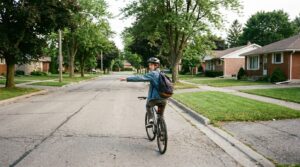
Look, signal, wait, move
A signal is not permission. Wait for the nod.
1The signal into nothing
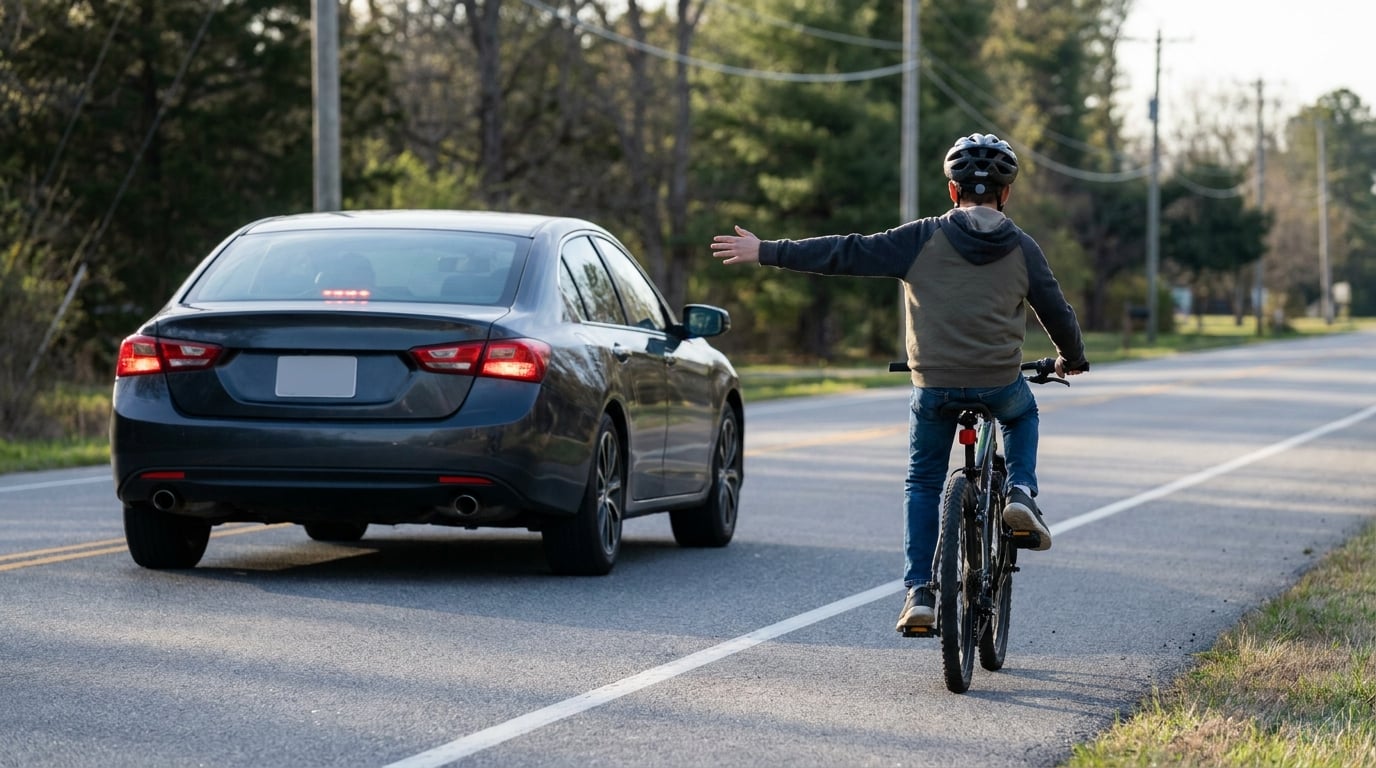
A rider puts an arm out for a left turn and starts moving across in the same moment. Behind them a car has not slowed at all.
Everything about that was correct except the order. The arm went out and the bike moved at the same instant, and nobody ever checked whether the arm had worked.
2The four signals
The federal teaching handout gives four, and these are the ones drivers are taught to read.
Left turn — left arm straight out to the side.
Right turn — right arm straight out to the side.
Right turn, the other version — left arm out and bent up at the elbow, palm forward.
Slowing or stopping — an arm out to the side and bent down at the elbow, palm backwards.
Use the straight right arm for a right turn: it is unmistakable and easier to hold. Learn to read the bent-arm version anyway, because adults who learned in a car use it and you need to know what it means when it is in front of you. The slowing signal is described slightly differently from one rule book to the next, so hold it clearly and low where it can be seen.
3Then the part almost nobody teaches
The national standard writes the routine as four steps, in this order.
Look behind for following vehicles.
Communicate your intentions to anybody ahead or behind who needs to know.
See that they have responded to your signal.
Then perform the manoeuvre.
That third step is missing from almost every American youth resource there is. A signal is not the end of the transaction and it is not permission. It is a message, and a message you have not seen land is just an arm in the air.
4What responded actually looks like
You are not waiting for a wave. You are waiting for a change: the car slowing, a gap opening where there was not one, the driver’s head turning towards you, the rider behind you easing off. Something out there has to be different because of the signal you gave.
The standard also says communication runs on three channels, not one: arm signals, riding position and eye contact. Where you are on the road is already telling people something before any arm goes out, and eye contact is often the thing that gets you the response you are waiting for.
5You signal, and the car behind does not slow.
Pick one.
Yes, and that is the whole badge in one decision. Nothing has responded, so nothing has been agreed. You hold your line, keep looking, and you go when something behind you changes. The move is the last step, and it does not happen until the third one has.
The signal is not the permission. A driver who has not slowed has either not seen you or has decided not to yield, and neither of those gets better because you moved into their lane. A bigger gesture is still only a gesture — what you need is a change in what the traffic is doing.
6Run the loop
A turn you are approaching, with four buttons: look, signal, see the response, move. Press them in any order you like. The card plays out what happens each time, including the two orders that look completely normal and still put you across the front of something.
The version where you signal and move in the same moment is worth running twice, because it is the one nearly everybody actually does.
7Which count as somebody responding?
Pick every one that is right, then press Check.
Find all 3.
Three. A response is something THEY did, that you saw.
Three of those are about you, or about nothing happening. Silence is not a yes.
8The four steps, in order
Say it out loud, in your normal voice
Look. Signal. See them respond. Then move.
Say the whole thing out loud on every practice turn. The fourth step is the one that wants to cut the line, and saying the third one out loud is the thing that stops it.
9Before you leave this page
Five turns. Name what the traffic did first.
Get somebody to ride or walk behind you in your practice space and act as the traffic. For each of five turns: look behind, give the signal, hold it until they do something you can see, say out loud what they did, and only then turn. They tick a turn only if you named what they did before you moved.