
You are the heaviest thing
Road Badge › Paths and People › You are the heaviest thing
You are the heaviest thing
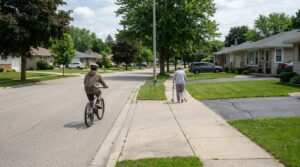
The person ahead has no helmet and no brakes.
1Nothing has happened yet
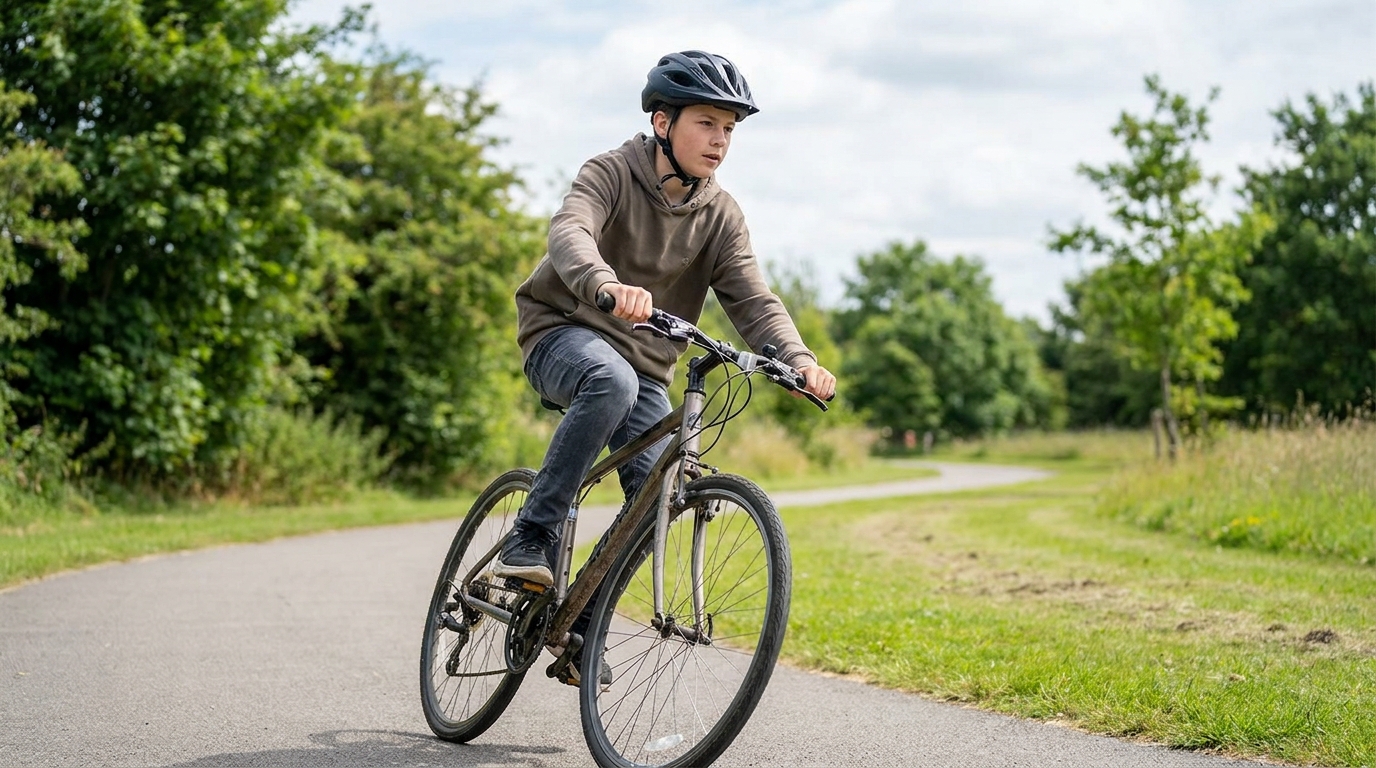
A shared path on an ordinary afternoon. You come round a gentle bend at a decent speed. Ahead, a woman pushing a buggy is walking two abreast with a friend, and a small child is a few steps off to one side. About fifty feet between you.
Four people, none of them doing anything wrong, and only one of them knows the situation exists. That is the ordinary condition of a path, and it is what this section is about.
2The finding this section is built on
A hospital group published a series of e-bike and scooter crashes it had treated. Alongside the riders it counted sixty-nine people who had been struck while on foot, and it reported something about them that is easy to read past.
Those sixty-nine struck pedestrians suffered brain injuries at nearly double the rate of the riders. Not a similar rate. Nearly double. The person who gets hit on a path is, in that series, the one more likely to end up with the injury nobody fully recovers from.
3Why that is not surprising once you look at it
The study reports the rate. It does not print a reason, so here is the reasoning, and you can check every step of it yourself. You are wearing a helmet and they are not. You know a collision is possible and they do not. You are holding on and they are not braced for anything.
And the last one is the biggest. You are carrying all of the speed and all of the weight. A machine with a motor and a battery on it, plus you, arriving at a person who weighs less and is doing walking pace. Everything that gets shared out in that collision was brought there by you.
4What each of you brought
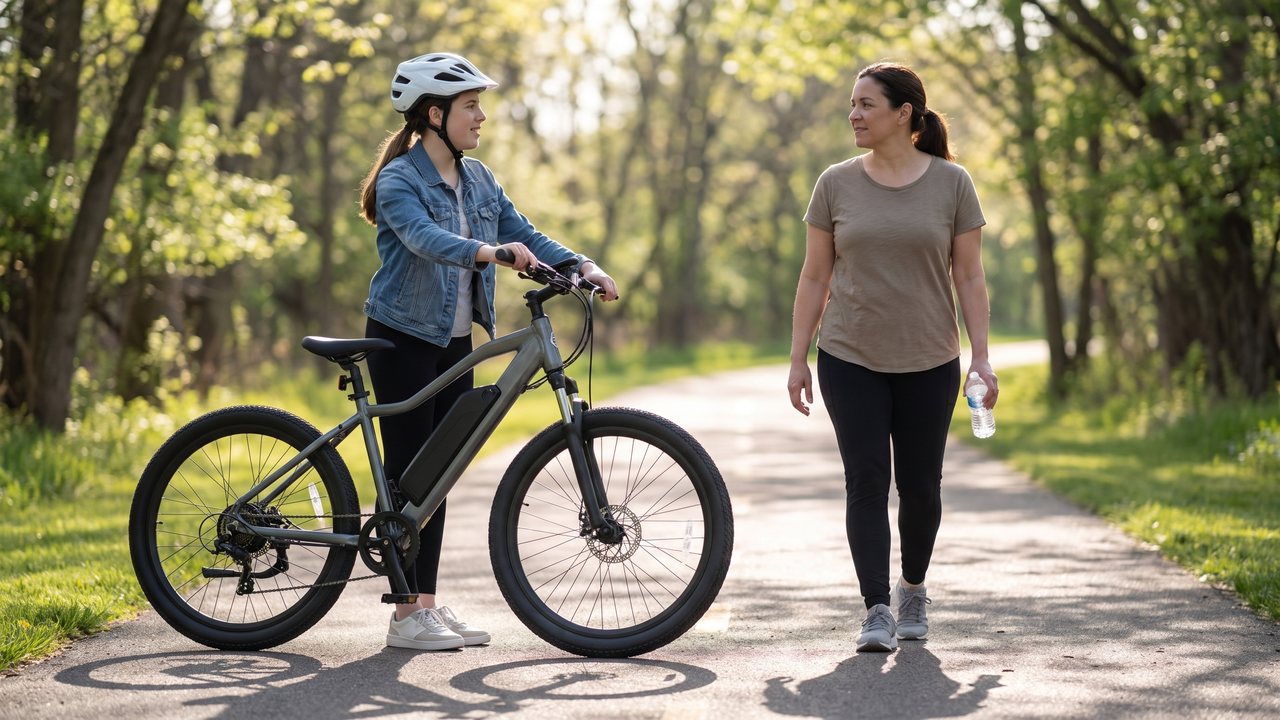
Put the two of you side by side. You have a helmet, a bike that weighs a lot, and the speed you are carrying. The person walking has a coat and a bag.
One of those lists is long and the other is empty. That difference is not about who is careful. It is about which of you is the vehicle, and on a path it is always you.
5So a path is a road with the roles swapped
On a roadway you spent two whole badges learning that you are small, that drivers do not see you, and that the vehicle carries the duty of care. All of that was true and none of it has changed.
On a path you are the car. You are the fastest and heaviest user, you are the one who arrives from behind where nobody is looking, and every rule in the rest of this section exists for the same reason the rules in badge five existed. The role swapped when the surface changed, and most riders never notice the swap.
6A path is quiet, and you are running late.
Pick one.
Yes, and the reason is what is behind the bend, not what is in front of you. A path is quiet right up until it is not, and the person who appears is the one who takes the worse injury. Riding at a speed you could stop from is the whole of it.
Look at where the speed gets spent. Both of those save time on the stretch where nothing is happening and arrive at the bend with all of it still on. Slowing down when you see somebody is a plan that needs you to see them first, and the ones that hurt people are the ones nobody saw.
7How much path do you actually have
A straight stretch of path with a person walking away from you on it. Set your speed and their speed with two sliders and watch the gap close in real time, with the distance and the seconds counting down. Then set the same speeds again with a hedge and a bend put in, so they only appear halfway through.
Run it once with the bend in and watch what your own numbers do to the seconds you have. Nothing in that is our claim about anything — it is your two numbers and arithmetic.
8A path is a road with roles swapped
Pick every one that is right, then press Check.
Find all 3.
Three. On a path you are the heaviest, fastest, best protected thing on it.
Three of those credit them with knowing you are there. They did not choose this.
9The sentence for the top of every path
Say it out loud, in your normal voice
On here, I'm the vehicle.
Say it at the trailhead, before your wheels are on the path. It is four words and it moves you from the middle of the picture to the edge of it, which is where you actually are once the surface changes.
10Before you leave this page
Count ten walkers. How many changed direction?
Go to the busiest bit of a path you actually use, stand at the side of it with an adult for five minutes, and count. Out of the first ten people who go past on foot, say out loud how many changed direction, stepped sideways, stopped or turned round without looking behind them first. Tell whoever is with you the number you got.