
The sidewalk is the worse one
Road Badge › Where You Are Allowed › The sidewalk is the worse one
Road Badge› Where You Are Allowed
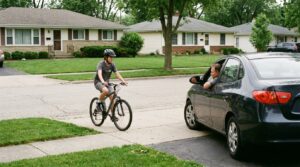
The sidewalk is the worse one
It feels safest and measures out worst.
1The driveway
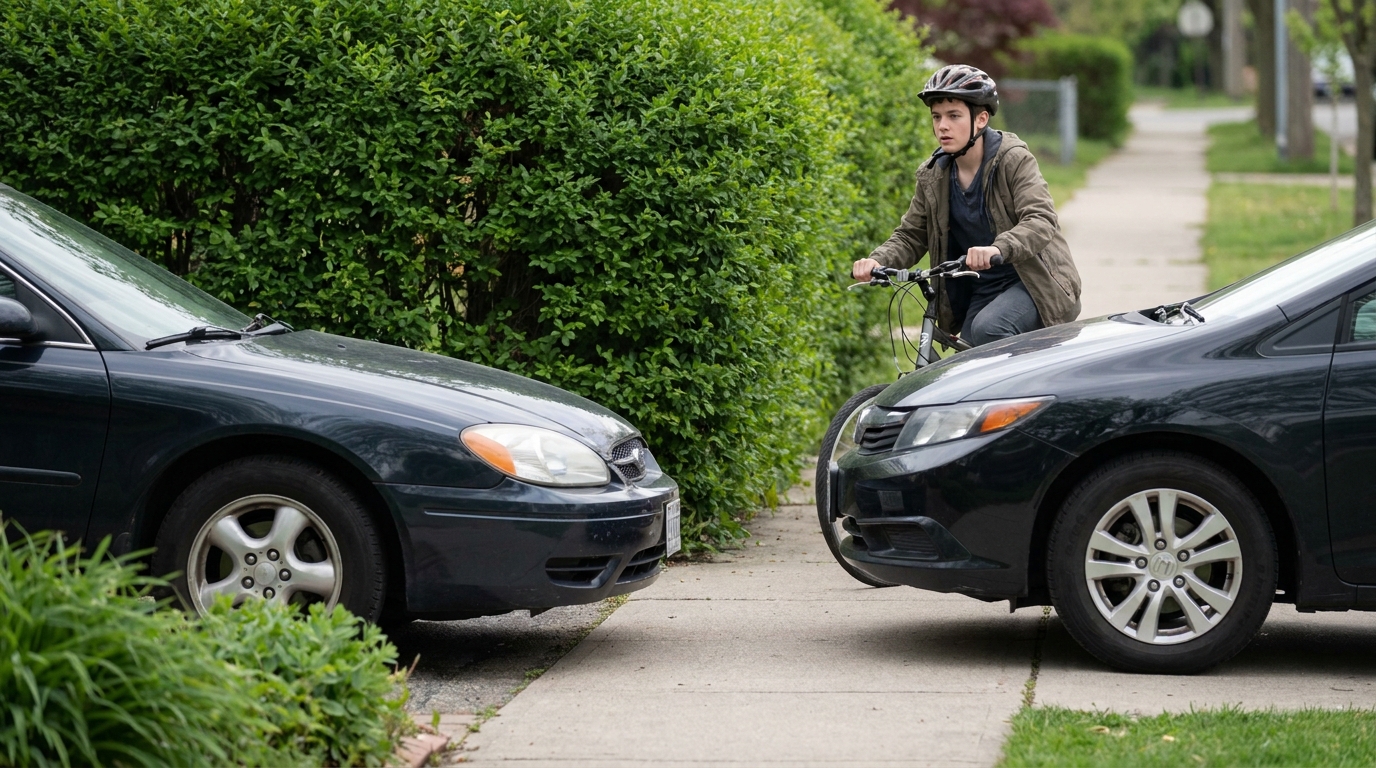
You are riding along a sidewalk past a hedge. Ahead, a car is nosing out of a driveway, its front already across the concrete. The driver is looking up the road, away from you. You are about ten feet short of it.
The driver is not being careless. They are looking exactly where they were taught to look, for traffic on the road. You are not on the road, you are behind a hedge, and they have no reason to look there.
2Everybody's instinct, parents included
The sidewalk feels like the safe one, and the reasoning is obvious: that is where the cars are not. Almost every adult who has ever worried about you on a road has suggested it, and none of them are being silly.
The measurements run the other way, and they have run the other way in every study anybody has done. This is the single hardest thing in this course to believe, so the rest of this lesson is the actual numbers and where they came from, rather than us telling you.
3The 1994 study, and the number that is about you
A study published in a traffic engineering journal in 1994 looked at eighty-nine bicycle and motor vehicle collisions at intersections in one Californian city and counted 2,976 riders to work out the exposure. It found that the average rider incurred a risk on the sidewalk 1.8 times as great as on the roadway.
Then it separated out direction of travel and found something larger. Riders traveling against the direction of traffic were at on average 3.6 times the risk of those traveling with it — and as high as 6.6 times for those seventeen and under. That last band is the exact age band this course is written for.
4Why the sidewalk produces that, mechanically
The same paper names the link: sidewalk riding appears to increase the incidence of wrong-way travel. A sidewalk has no direction. You use whichever side you started on, and half the time that is against the traffic on the road beside you.
And then there is the driveway. A driver pulling out looks up the road, for something moving at road speed, at the place a road-user would appear from. You arrive from behind a hedge or a parked car, on a strip they are not searching, moving several times faster than the walking pace that strip is designed around.
5Where the driver is actually looking
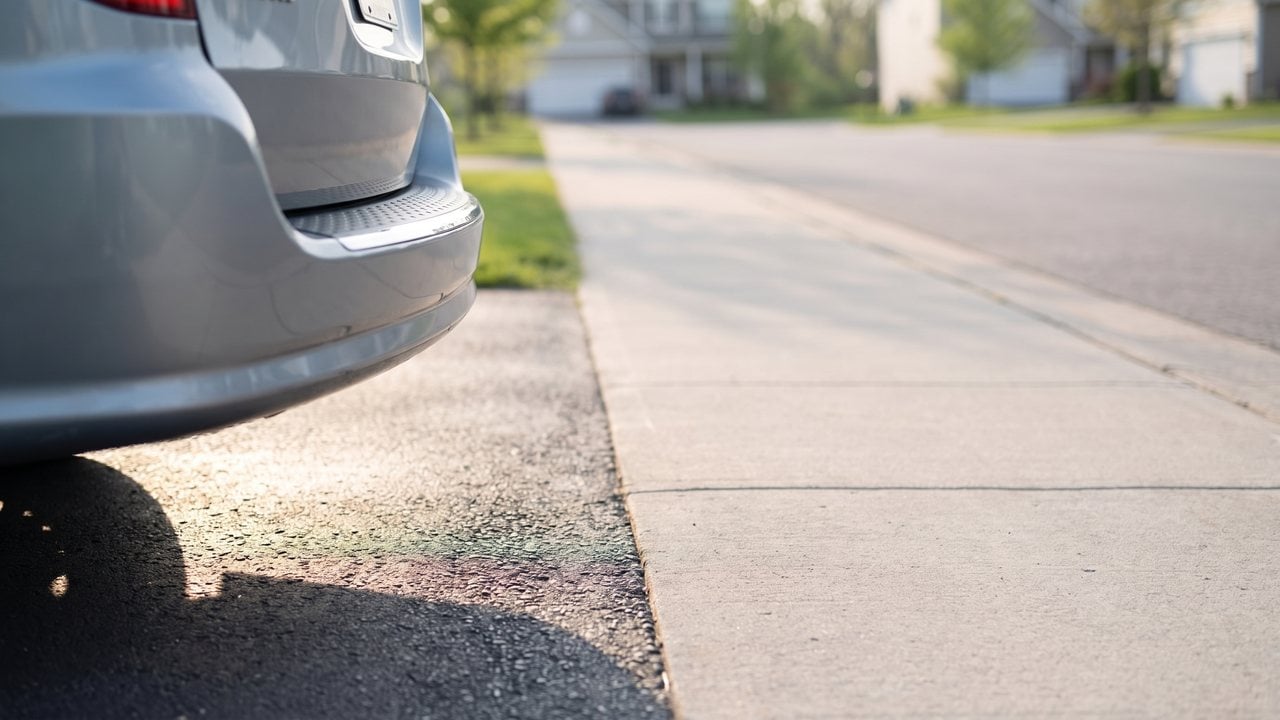
That cone is not carelessness, it is training. Everything a driver was taught about pulling out of a drive points them at the road, and the concrete in front of their bumper is checked for people at walking pace.
6Busier than you thought, three blocks left.
Pick one.
Yes, and walking is a genuine answer rather than a cop-out. Pushing it is the one option that takes you out of both problems at once: you are not in traffic, and you are moving at the speed the concrete and the driveways were designed around. Three blocks is about four minutes.
Both of those are the instinct, and the third one is the worst of the set. Riding against traffic is the behavior with the biggest measured multiplier in the whole literature, and it is largest for riders your age. Being able to see the cars coming does not help, because the ones that hit you come out of driveways and side roads and never see you at all.
7The falls, which nobody expects
A Toronto study followed commuting riders and worked out event rates per sixty thousand miles on each surface. Collisions: 8.2 on roads, 16.7 on sidewalks. Injuries: 10.9 on roads, 70.5 on sidewalks. And falls, which is the column nobody predicts: 11.4 on roads, 103.4 on sidewalks. The authors note that the result seems contrary to perceived notions of safety.
Almost none of that falls column is about cars. It is driveway lips, curb edges, sign posts, joints in the concrete, trash cans, and somebody stepping out of a doorway three feet in front of you. A sidewalk is a surface built for feet, and a machine this heavy meets all of it at speed.
8Which of these did the research find?
Pick every one that is right, then press Check.
Find all 4.
Four. The sidewalk measures out as the more dangerous of the two, not the safer.
Two of those trust the sidewalk. Drivers leaving a drive are not looking there.
9And the reason the official numbers hide it
In one of those studies, of fifty-two sidewalk events, not one was reported to police — and some of them caused major injuries. Nobody calls anybody when a rider goes down on a curb lip, so none of it reaches a crash statistic.
So any argument built on official crash counts understates this by a long way. None of which means you are wrong for using a sidewalk, and in some places, at some ages, the sidewalk is exactly where a younger rider is told to be. It means: if you use one, ride it as a different thing. Walking pace near driveways, treat every driveway as an intersection, and never against the direction of the traffic beside you.
10The line for a friend heading up the curb
Say it out loud, in your normal voice
I'll take the road. I'll see you there.
It says what you are doing and nothing about what they are doing, so there is nothing in it to argue with. You are not running a campaign at the curbside, you are just going a different way for four minutes.
11Before you leave this page
Watch three cars leave a driveway.
With an adult, stand at a driveway on a route you actually use and watch three cars come out of drives. For each one, say out loud where the driver’s head was pointing, and at what moment they first looked at the sidewalk. Then say how far up the sidewalk you would have been by then.