
The dog
Road Badge › When It Goes Wrong › The dog
Road Badge› When It Goes Wrong
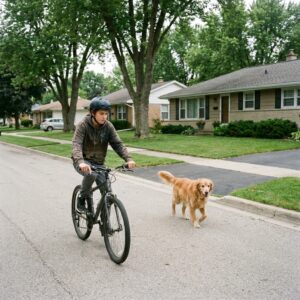
The dog
Do not outrun it. Put the bike between.
1Out of the gate
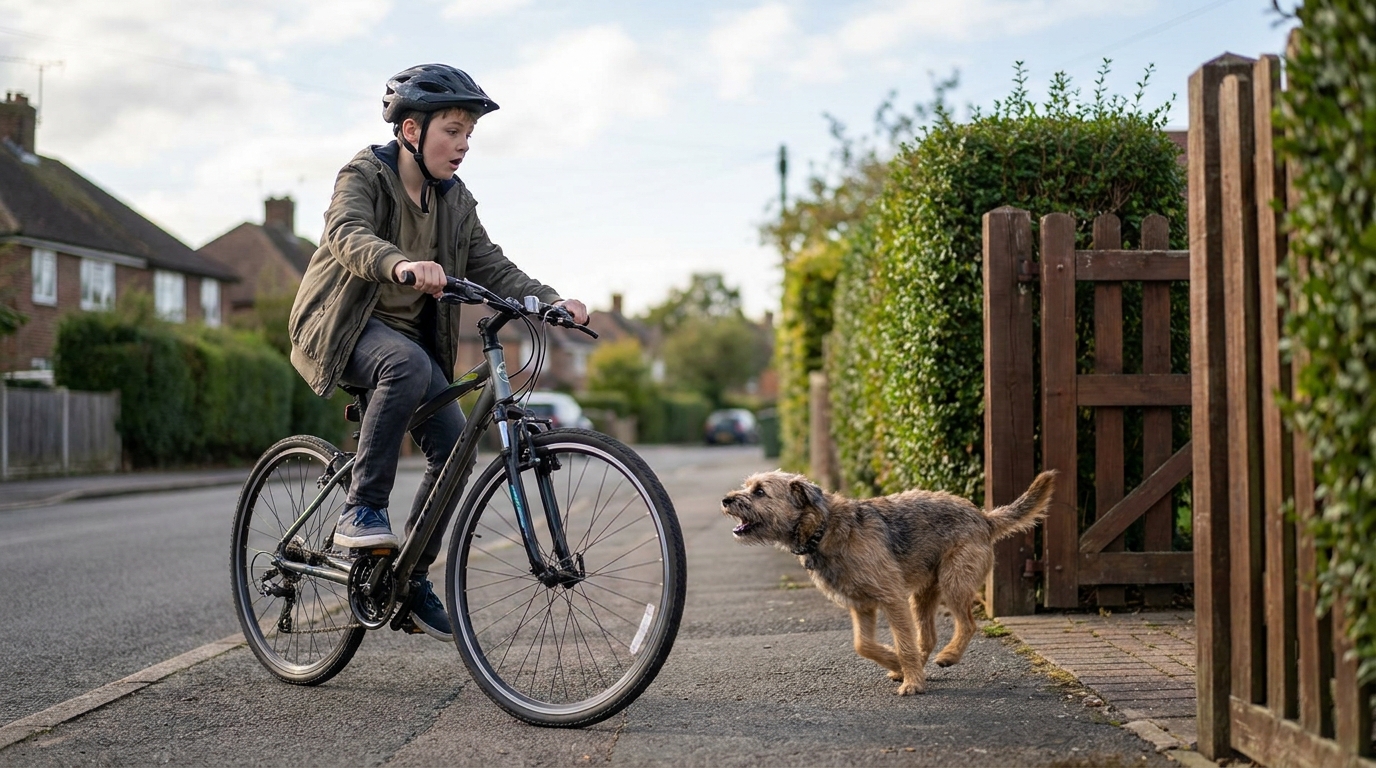
You are passing a house on a quiet street when a medium-sized dog comes out from behind a gate at a run, barking, angling to cut across your front wheel. It is about ten feet away.
This one is worth stopping on, because two respected manuals would tell you to do opposite things in the next second, and neither of them is being careless.
2What each source actually says
The motorcycle manual: downshift and approach the animal slowly, and as you approach it, accelerate away and leave the animal behind.
The cycling handbook: do not try to outrun the dog unless you are a very strong rider, and do not try anything beyond your bike-handling skills. Its own suggestions are a loud firm voice, just stop — the dog may stop too, letting you walk or ride slowly away — and get off quickly, using the bike as a barrier if the dog attacks.
3Why they disagree, and both are right
A motorcycle can outrun a dog and a bicycle usually cannot. Each manual is right about its own machine. That is the whole disagreement, and once you see it you can see why nobody has to be wrong.
An e-bike sits exactly in the gap, and nobody has resolved it. It is faster than a bicycle and slower than a motorcycle, and we could not find a source that has done the work for our machine. So this course tells you which side it is teaching, and why, rather than pretending the sources agree.
4Two manuals, one page each

The motorcycle page says accelerate away and leave the animal behind. The cycling page says do not try to outrun the dog.
Both of those are real, current, and written by people who know what they are doing. Being able to hold two sources that disagree and still act is a skill in itself, and it is not only about dogs.
5Which one this course teaches, and the reason
The cycling one. A teenager trying to outrun a dog on an assisted machine is a teenager accelerating hard while looking sideways at an animal, on a street, with one hand doing two jobs. That is a way to crash without the dog ever touching you.
And three of the handbook’s items need no equipment and no skill at all, which is why they are the ones to have.
A loud, firm voice.
Just stop. The dog often stops too.
Get off, and put the machine between you and it.
Some of the handbook’s other suggestions involve sprays and whistles. Whether those are lawful for somebody your age varies and we have not verified it, so this course does not tell you to carry anything.
6A dog comes at you from a driveway.
Pick one.
Yes, and it is the answer the cycling handbook gives in its own words. Stopping often stops the dog. A firm voice does a surprising amount of the work. And the machine is a wide metal barrier that you happen to be holding, which is the most useful thing about it in that moment.
Both of those need something you do not have. Outrunning it needs a machine faster than a dog and full attention forward, and you would be looking sideways. Kicking needs one foot off a pedal and your weight on a machine that is now steering itself, ten feet from an animal — that is a fall, with or without the dog.
7The voice, and it has to be the loud one
Say it out loud, low and hard, not high and quick
No. Bad dog. Go home.
Those are the handbook’s own words, and the tone matters more than the words do. Practice it now in a room, because a voice you have never used is not a voice that arrives in ten feet, and most people’s first attempt comes out far too high and far too quiet.
8Which of these are on the handbook list?
Pick every one that is right, then press Check.
Find all 4.
Four. The bike goes between you and the dog, and you use your real voice.
Two of those put you within reach. Kicking and outrunning both end badly.
9Sort the two manuals
Ten instructions arrive one at a time, drawn from the motorcycle manual, the cycling handbook and a couple of things people say that are in neither. Sort each into motorcycle, cycling or nobody said this. The card then shows which machine the instruction was written for and whether it survives the trip onto an e-bike.
The four cards that end up in nobody said this are the interesting ones. All four are things riders repeat confidently, and none of them are written down anywhere we could find.
10Before you leave this page
Put the bike between you and the dog. Say it.
Two minutes, standing still. With an adult, put a marker on the ground for the dog, get off the machine and set it between you and the marker the way you would actually hold it, and say no, bad dog, go home in the real voice. Do it three times. Then walk the route you ride most and mark on a map where the dogs on it actually are, because the ones that come out are almost always the same ones.