
You are traffic
Road Badge › You Are Traffic › You are traffic
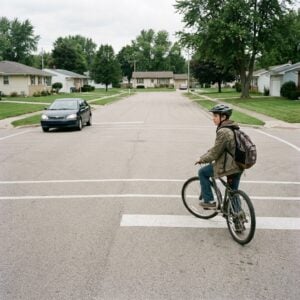
You are traffic
Same rights, same duties. All of both.
1Nobody here knows who goes first
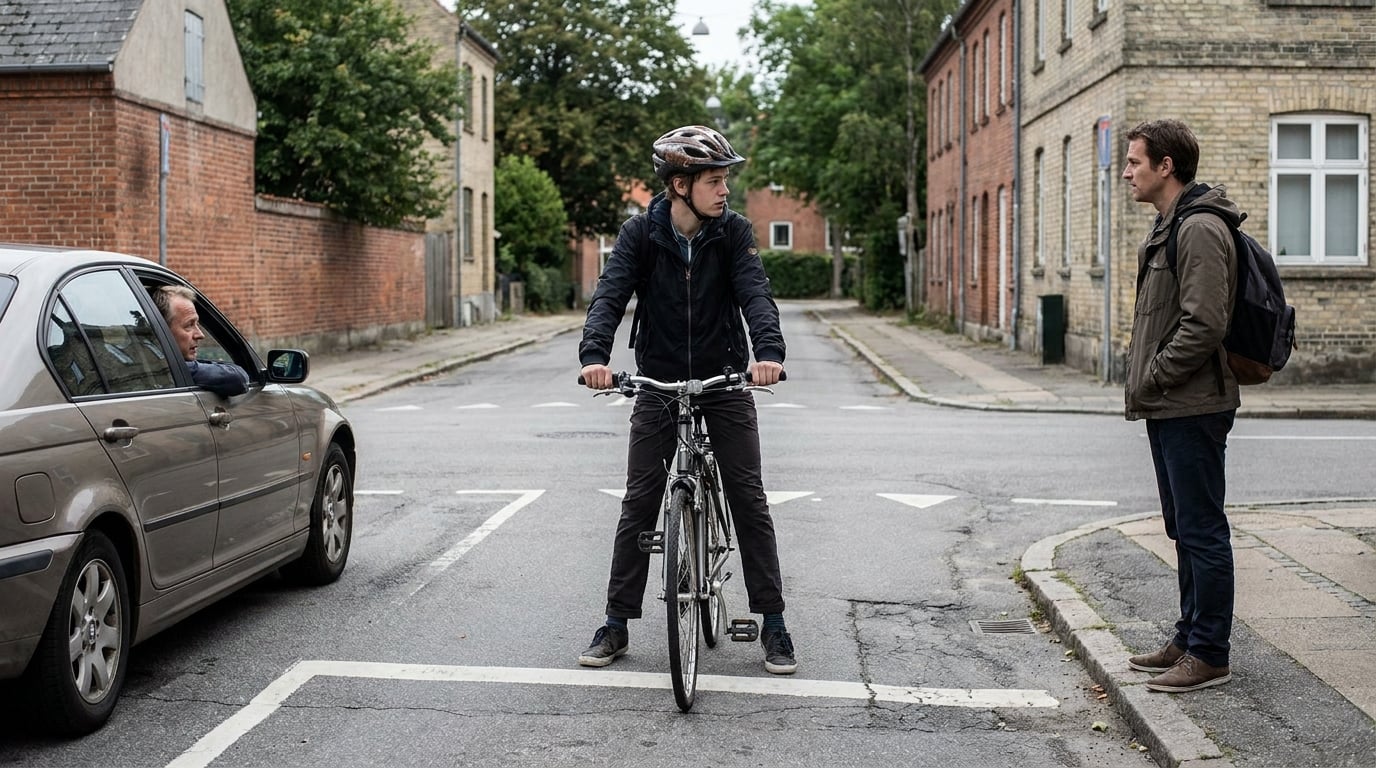
You arrive at a junction at the same time as a car and somebody on foot. Each of you is waiting to see what the others do.
That hesitation is the whole problem. A road works because everybody can predict everybody else. The moment nobody knows who goes first, everybody guesses.
2One sentence, and both halves arrive together
Here is the line, from a real vehicle code, in the words it is written in: every person riding a bicycle upon a highway shall be granted all of the rights and shall be subject to all of the duties applicable to the driver of a vehicle. Other places word it differently and mean the same thing.
It is one sentence. The rights and the duties are joined in it with an and, and there is no version of the law where you are handed the first half on its own. This is one of the very few things about riding that is true in essentially every state and every province.
3What the rights half actually contains
You are entitled to be on the road. Not tolerated on it, not a guest on it, not there because a driver is being generous. You are a vehicle operator using a public road for the purpose it was built for, and you do not need anybody’s permission to be there.
It also means you are entitled to a lane and to your turn. At the intersection in that film, whoever arrived first goes first, exactly as it would be between two cars. Nobody has to wave you through, and a wave is not what decides it.
4Two halves of one sentence
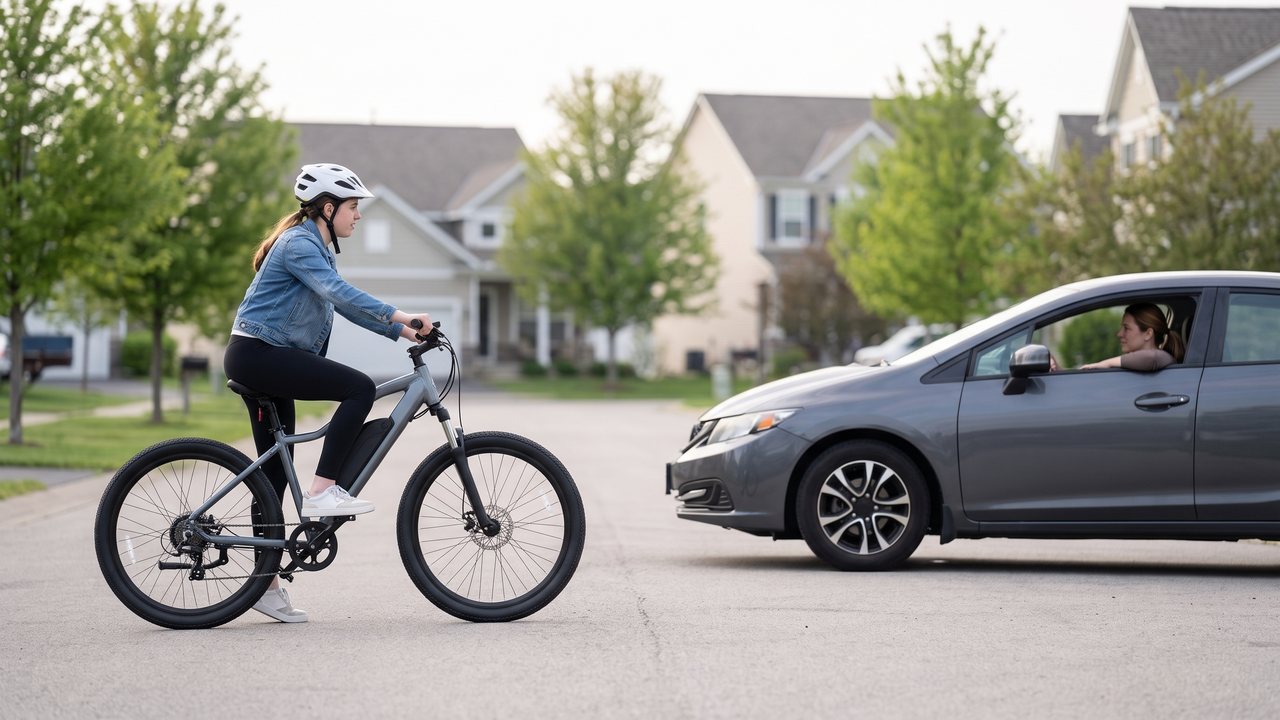
Riders tend to have read the left half and drivers tend to have read the right half. It is the same sentence, and it is not two rules that happen to sit near each other.
5And what the duties half contains
The duties are not a special set written for you. They are the ordinary ones, and you already know them from the passenger seat.
Stop at stop signs and red lights.
Travel in the direction the traffic in your lane travels.
Signal before you turn or change position.
Yield wherever a driver would have to yield.
The awkward part is the timing: the duty arrives at exactly the same moment as the right. A rider who wants the intersection treated as theirs is also the rider who stops at the sign fifty feet before it. You cannot take the first without the second, because they were never separate.
6A stop sign, and nothing coming at all.
Pick one.
Yes, and it is worth knowing why rather than just doing it. The sign and the lane come out of the same sentence. Being the vehicle that stops is what makes you the vehicle that gets its turn, and it is the only version of this that a driver can predict from a hundred feet back.
Have a look at where the rule you are using comes from. The reason you are entitled to that intersection at all is the same clause that puts the sign in front of you. Stopping only when watched turns it into a thing about getting caught, and the rider who does that is unpredictable to everybody around them, which is the expensive part.
7Sort the sentence
Twelve cards, one at a time: the lane, the stop sign, your turn at an intersection, the direction of travel, being passed with room, signaling, being seen at an intersection, red lights, right of way where a driver would have it, yielding, riding predictably, and being treated as a vehicle. Drop each into rights or duties. The card then shows you which single sentence both piles came out of.
Do it once and notice how many of the cards you had to think about. Most riders can fill one pile fast and the other one slowly.
8Which of these are duties you carry on a roadway?
Pick every one that is right, then press Check.
Find all 4.
Four duties. The same sentence that gives you the lane is the one that binds you.
Two of those are not duties. You do not owe anybody the road, and you do not wait to be waved on.
9The whole badge in one line
Say it out loud, in your normal voice
I get the lane. I get the stop sign too.
Say it once now. It is the sentence to have ready for anybody who tells you to get on the sidewalk, and it is also the one that stops you arguing for the first half only.
10Before you leave this page
Find the sentence for where you live.
Go and find the sentence for where you live. Search your state or provincial vehicle code for the words rights and duties together with bicycle, read the sentence you find out loud to somebody, and tell them which four duties on your route you carry because of it.