
Six of you is one vehicle
Road Badge › Paths and People › Six of you is one vehicle
Six of you is one vehicle
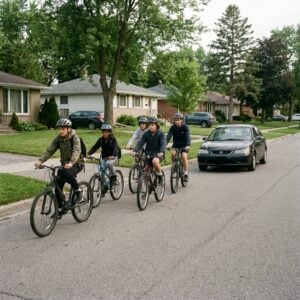
A group is one long vehicle. Nobody dropped.
1Five of you, and one of somebody else
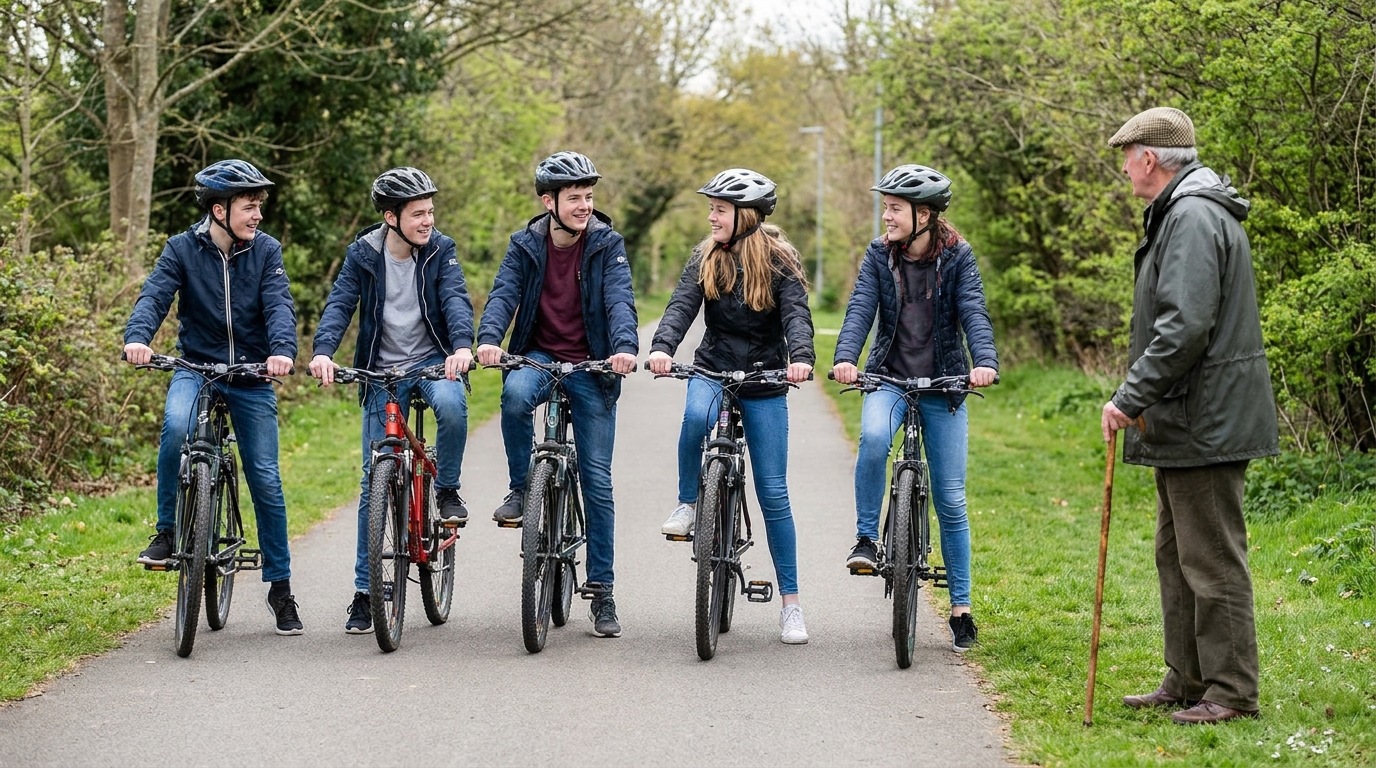
Five riders come along a shared path in a loose bunch, spread across the full width, talking. Ahead, an older man with a walking stick is coming the other way and has stopped at the edge to wait.
Nobody in that group has done a single thing they would call wrong, and the man has already had to stop and get out of the way. That is what a group does without anybody deciding to.
2What changes when there is more than one of you
Riding with friends changes three things at once and none of them are about skill. You are longer — a person on foot has to wait for all of you, not for one of you. You are wider, unless somebody decides otherwise. And you are looking at each other rather than at the path.
So a group has to be organized, or it organizes itself badly. The path rule for it is short and it is in every source: when you travel side by side, stay on the right half of the path. Your half is your half whether there is one of you or six.
3The four formations, and how you choose
School bike-bus guidance names four, and the choice is made by the road or path, never by preference.
Side by side, no more than two riders.
Single file.
The whole roadway, on streets with low traffic and low speeds.
The sidewalk, where that is the best option in that location.
Two cautions on that last one and they are real. Sidewalks are a town-by-town answer, and for a group of e-bikes that formation is simply unavailable in a lot of places. And how many riders may ride side by side on a road is another local answer that varies — that is a badge six job, and you already know how to go and find it.
4Three jobs, and they are named
An organized ride has three adult roles with names, and knowing them is useful even on a ride of three friends.
Front rider — sets the pace, holds the line everybody follows, and watches ahead for intersections and traffic.
Corker — goes ahead at an intersection and holds the crossing traffic until the group is through.
Sweeper — rides at the back, and their whole job is that nobody falls behind.
The guidance also puts a ratio on it: one adult for every three to six children is advisable. And the rules given to the riders themselves are three: stay behind the lead rider, give space to the riders around you, and communicate with the riders near you.
5Put the group on the road
Six stretches arrive one at a time: a wide quiet residential street, a busy shared path on a Saturday, a narrow path with walkers on it, a low-speed street with almost no traffic, an intersection the group has to cross together, and a section where the path narrows to a bridge. Choose a formation and place the front rider, corker and sweeper. The card gives the guidance's own answer and what goes wrong with the others.
The intersection is the one worth running twice. It is the only one of the six where somebody has to leave the group to make it work.
6Four of you, two abreast, a runner coming.
Pick one.
Yes, and the call out loud is the part that makes it work. Four riders do not go single file because they each individually thought of it. Somebody says it. Faster yields to slower, and a group of four is the fastest thing on that path by a distance.
Both of those hand your problem to the runner. Making somebody step off the asphalt is you taking their half as well as yours, and it is exactly the yield rule pointing the wrong way. And arriving faster just gives them less time to work out what six wheels are about to do.
7How long four of you actually are
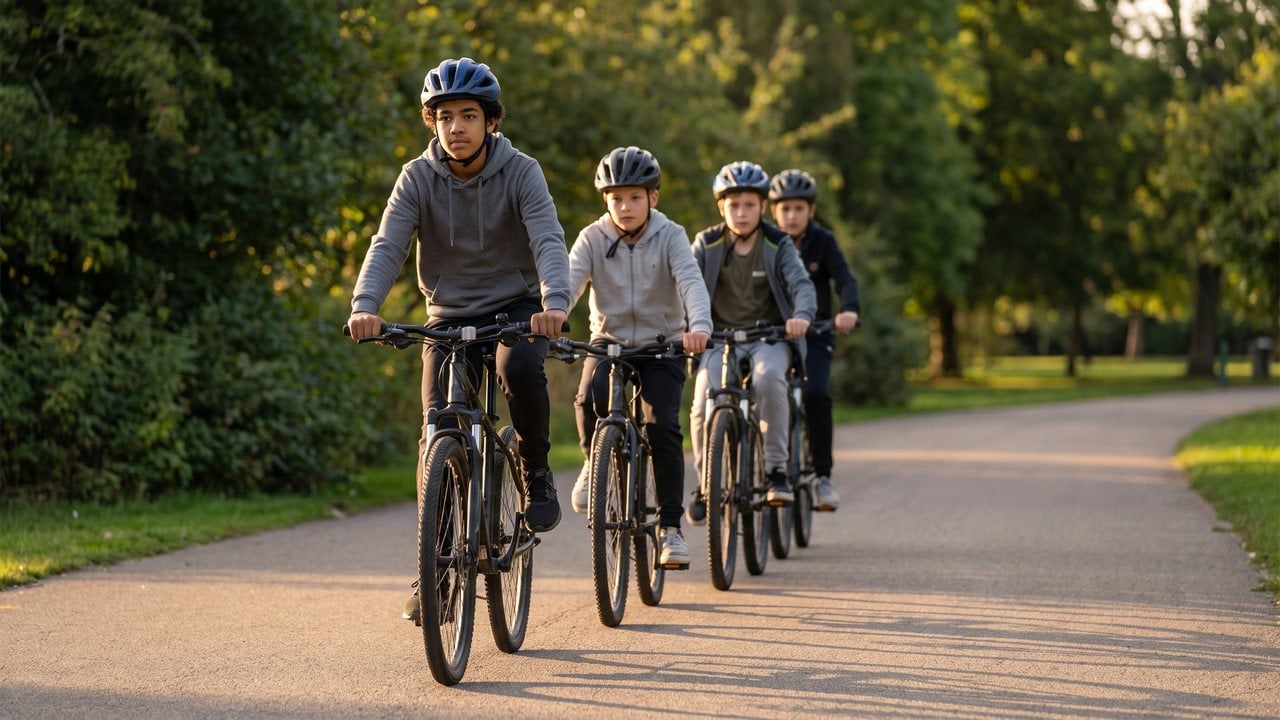
That measurement is the thing nobody in the group can see, because every one of you is looking at the rider in front. A person coming the other way is dealing with the whole length of it, not with you.
8Which of these are somebody's job?
Pick every one that is right, then press Check.
Find all 3.
Three real jobs: the front, the crossings, and the back.
Three of those are not jobs, they are opinions. Nobody's role is being fastest.
9The call that changes the shape
Say it out loud the way you would need it heard four bikes back
Single file. Coming through.
Say it early, so the shape has changed before the meeting rather than during it. On a ride with friends, whoever sees it first calls it, and there is no rule that the person at the front has to be the one who notices.
10Before you leave this page
Go single file in three seconds, five times.
Get one other rider and a witness onto a quiet path or an empty lot. Ride two abreast on your half, and on the witness’s signal go single file within about three seconds, with one of you calling it out loud. Do it five times, swapping who calls. They only tick a run where the call came before the change and both of you stayed on your own half of the width.