
People do not go straight
Road Badge › Paths and People › People do not go straight
People do not go straight
Leave a few feet. Assume they will move.
1Where everybody actually went
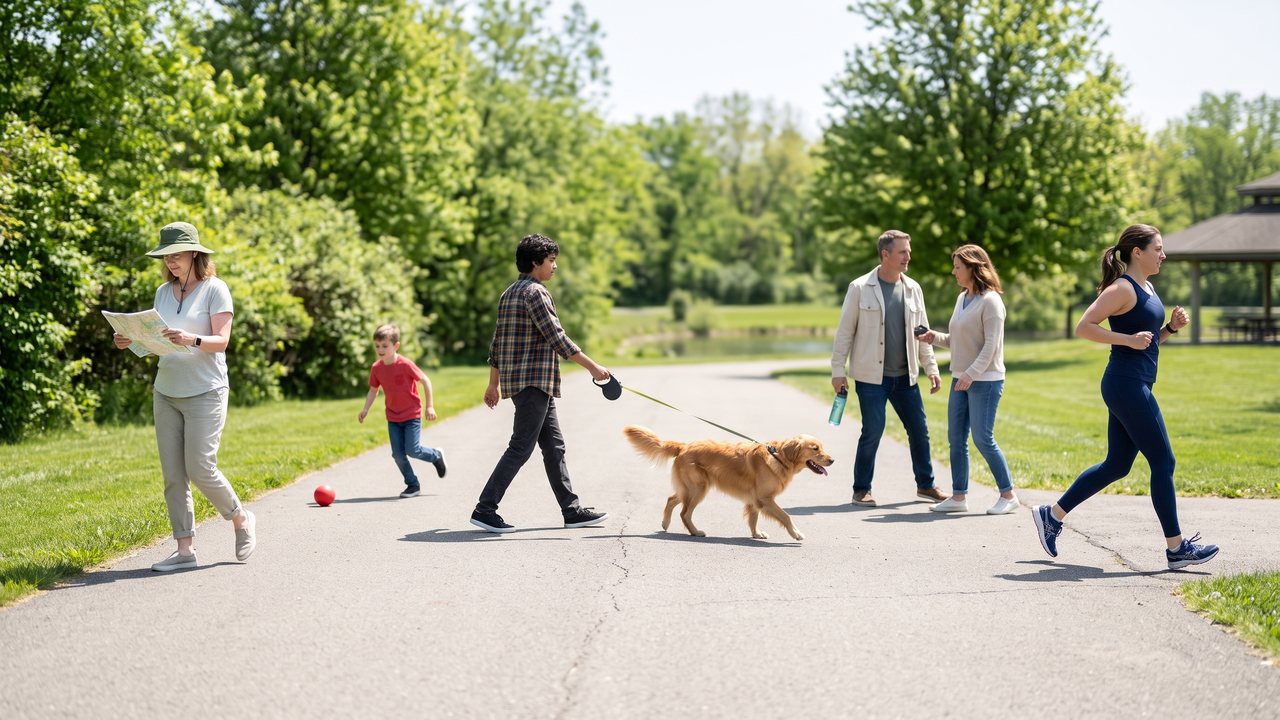
Six people, sixty seconds, and not one straight line among them. That drawing is the single most useful thing in this lesson and it is why the spacing rule exists.
2The sourced instruction, which is short
Here is what a trail authority actually writes, and it is worth having in the words they use: small children and dogs are unpredictable, so leave a comfortable space of a few feet when passing. That is the instruction. A few feet, every pass, not just the passes that look tricky.
And that is where the sources stop. We went looking for authoritative guidance on what a toddler or a dog specifically does and could not find any, so this course does not invent some. What you get is the general rule, which is well supported, plus the thing you can observe yourself.
3Which is that people drift
You counted this yourself at the end of the first lesson in this section. A person walking is not on rails. They drift towards the middle, they step round a puddle, they turn to talk to somebody, they stop dead to look at a phone, and they change their mind about which side of the path they are on. None of that is them being careless. That is what walking is.
So the space is not politeness. The gap you leave is the amount of sideways movement you have already forgiven them for. Pass close and you have decided they will hold a line, which the drawing at the top of this lesson says they will not.
4Give them the room
A path seen from above with a person walking on it and a rider approaching from behind. Drag the rider's passing line closer or wider, then press go and watch the pass run several times with the walker drifting a realistic amount each time. The game counts how many of the runs end with contact at each width.
Run the close line ten times before you run the wide one. The point is not that a close pass usually goes wrong. It is that it does not have to usually go wrong to be a bad plan.
5And the fifth rule, which riders forget entirely
Every path authority checked writes this one down and almost no rider does it: move off the path when you stop. Not slow down at the edge. Off it — onto the grass, the shoulder, the gravel, the parking lot — and your machine with you.
A stopped rider on a path is a parked vehicle in a traffic lane. Everybody coming round the bend behind you now has to go round you, into the side other users are coming down, exactly the manoeuvre the last lesson told you not to make blind. Phone call, drink, message, chain, waiting for a friend: all of them happen off the path.
6A dog on a long lead, across the path.
Pick one.
Yes, and notice you used every rule in this section at once. Slow, call, wait for the reaction, then a wide pass. The reaction you were waiting for was a specific one: the lead coming in. Until it does, the path is not clear no matter how much room there looks to be.
Have a look at what a long lead actually is. It is a thin line across the whole path attached to an animal that can move faster than either of you. The gap between the dog and the person is not a gap. And a bell without a wait is the same mistake as a call without a wait, which is that nothing has been agreed yet.
7The parked vehicle
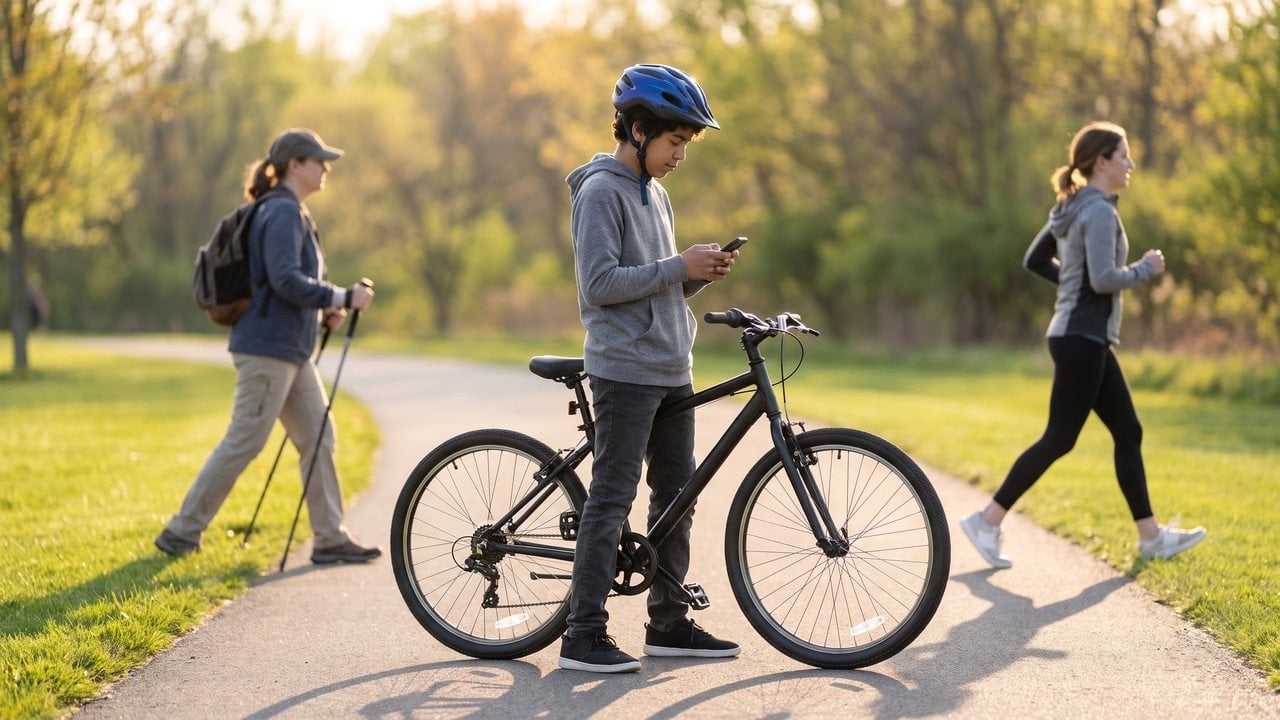
Nobody in that picture thinks of it as a hazard, including the rider in the middle. Look at where the two people going round have had to put themselves.
8Which of these mean you leave more room than usual?
Pick every one that is right, then press Check.
Find all 4.
Four. More room, every time, for anything that can move sideways without warning.
Two of those are you having done your bit. Correct walking and one shout are not room.
9The two-part rule, said as one line
Say it out loud, in your normal voice
Give them the room. Get off to stop.
Two habits, one line, and the second half is the one nobody does. Say it every time you reach for your pocket on a path, because that is the exact moment the rule is for.
10Before you leave this page
Pass a walker ten times, without moving them.
Chalk two lines a few feet apart on a quiet bit of ground and get somebody to walk along one of them, drifting a bit, the way people actually walk. Ride past them ten times on the far line, calling out first. They tick a run only if they never had to change what they were doing. Then do it once at the width you normally pass at, and ask them which one they preferred.