
Keep right, pass left
Road Badge › Paths and People › Keep right, pass left
Keep right, pass left
Call it out, then wait for them to react.
1Four rules, found separately by everybody
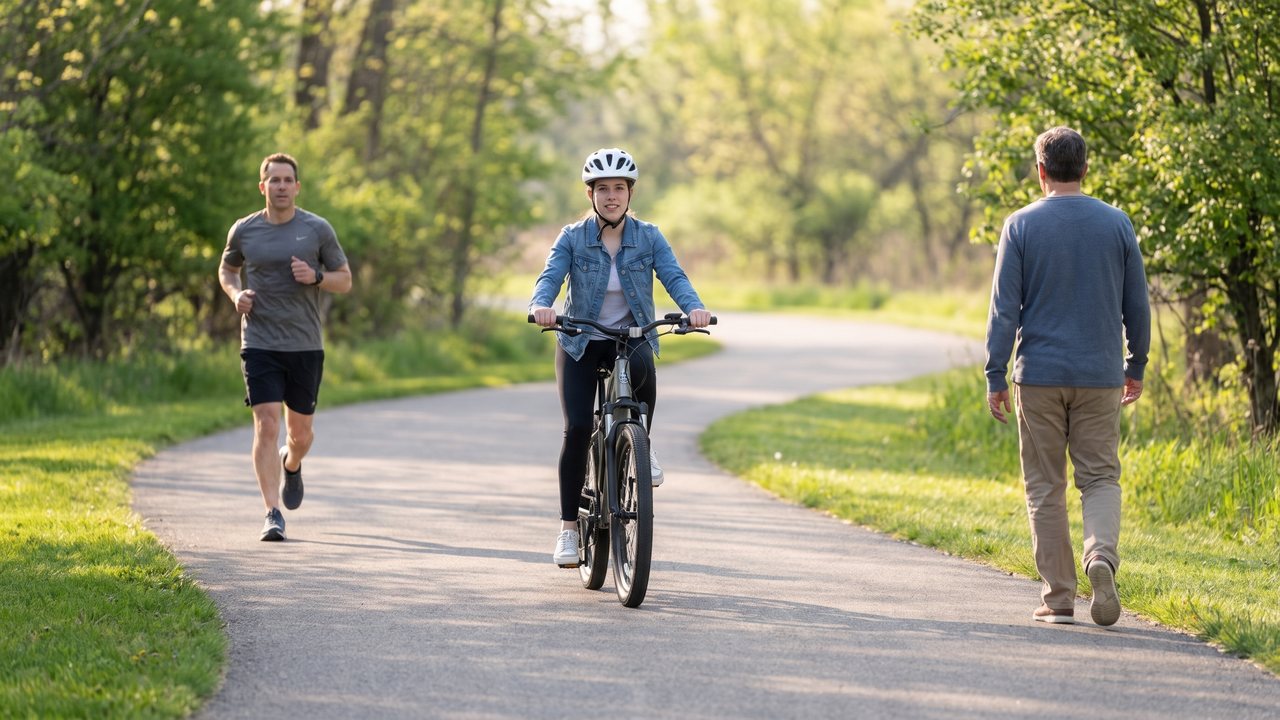
Keep right. Pass on the left. Call out before you pass. Faster yields to slower.
There is no national standard for how to behave on a shared path. What there is instead is every authority that has written rules arriving at the same four, which is a stronger thing than a standard.
2The four, in the words the trail authorities use
Keep right. All users stay to the right side of the path except to pass. Pass on the left. Single file, and passing happens on the left. Announce it. Call out before you overtake. Faster yields to slower. The quicker user gives way to the slower one, not the other way round.
That last one is the one riders argue with, and it is in every source checked. Being faster does not buy you priority on a path. It buys you the duty. It is the same trade you already know from the road, just with you on the other end of it.
3And the half of the passing rule that gets skipped
Here is a path authority’s own instruction, and it has four steps in it, not two: pass on the left by slowing down, giving an audible warning such as calling out excuse me, passing left, and waiting for a reaction before passing.
Waiting for a reaction is a step. Most riders do steps one and two and go. But a call you make is not information until it lands, and you have no idea whether it landed until the person moves, turns their head, puts a hand out, shortens a dog lead or does anything at all. Somebody with earbuds in never heard you and is entitled to be there.
4The call, out loud, at real volume
Say it the way you would need it heard from thirty feet back
Passing on your left.
Four words, said early and loudly enough to be heard over traffic, headphones and a dog. Practice it now in a room, because the reason riders do not call out on paths is almost never that they forgot. It is that it feels loud.
5A bell, a voice, and one place where this is law
The sources allow either a bell or your voice. Worth noticing what each carries: a bell says something is coming, and words say which side it is coming down, which is the part the person in front of you actually has to act on. A bell then your voice covers both.
And in at least one state’s vehicle code this stops being etiquette: a rider must give an audible signal before overtaking and passing a pedestrian. That is a statutory duty, in that state, on a sidewalk. It is an example, not automatically your rule — but it tells you how seriously this one gets taken.
6You call out and nobody reacts.
Pick one.
Right, and the reason is that nothing has actually been communicated yet. A call with no reaction is a call that did not land. Staying back costs you a few seconds and it is the only version where a sudden sideways step by them does not become a collision.
Look at what the warning was for. It was not a formality you complete before you are allowed past — it was to make the person predictable. Until they react, they are not, and passing an unpredictable person closely is the situation the whole badge is about. Leaning on a bell just makes somebody jump, and people jump sideways.
7Run the pass
A path with a walker ahead and four buttons: slow, call, wait for the reaction, go. Press them in any order and watch it play. The versions worth running are call-then-go with no wait, go-then-call, and the one where you slow and call and they still do not react, which is the one that has no button on it.
There is a fourth outcome the game will not let you button your way out of. That is deliberate, and it is the one you will meet most often.
8Which of these count as a reaction you can act on?
Pick every one that is right, then press Check.
Find all 4.
Four. Every one of them is something you can see them do.
Two of those are you assuming. Fairly sure is not a reaction.
9Whose path is it anyway
Whether a machine like yours may use a path at all is decided by whoever owns that path — not by your town and not by your state — and two paths a mile apart can answer differently. Path authorities have been adding patrols, and the reason they give is riders passing people badly.
10Before you leave this page
Call your pass until somebody hears it twice.
Get somebody to stand about thirty feet away with their back to you and music on. Call passing on your left in the voice you would actually use. They only tick it if they heard the words and could say which side you meant. Do it until you get two in a row, and notice how much louder that is than you expected.