
Riding with one hand
Road Badge › Look Behind, Ride Straight › Riding with one hand
Road Badge› Look Behind, Ride Straight
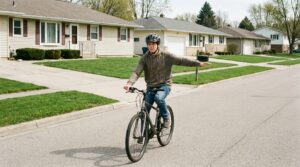
Riding with one hand
A hand off the bars costs you steadiness.
1The hand that came off
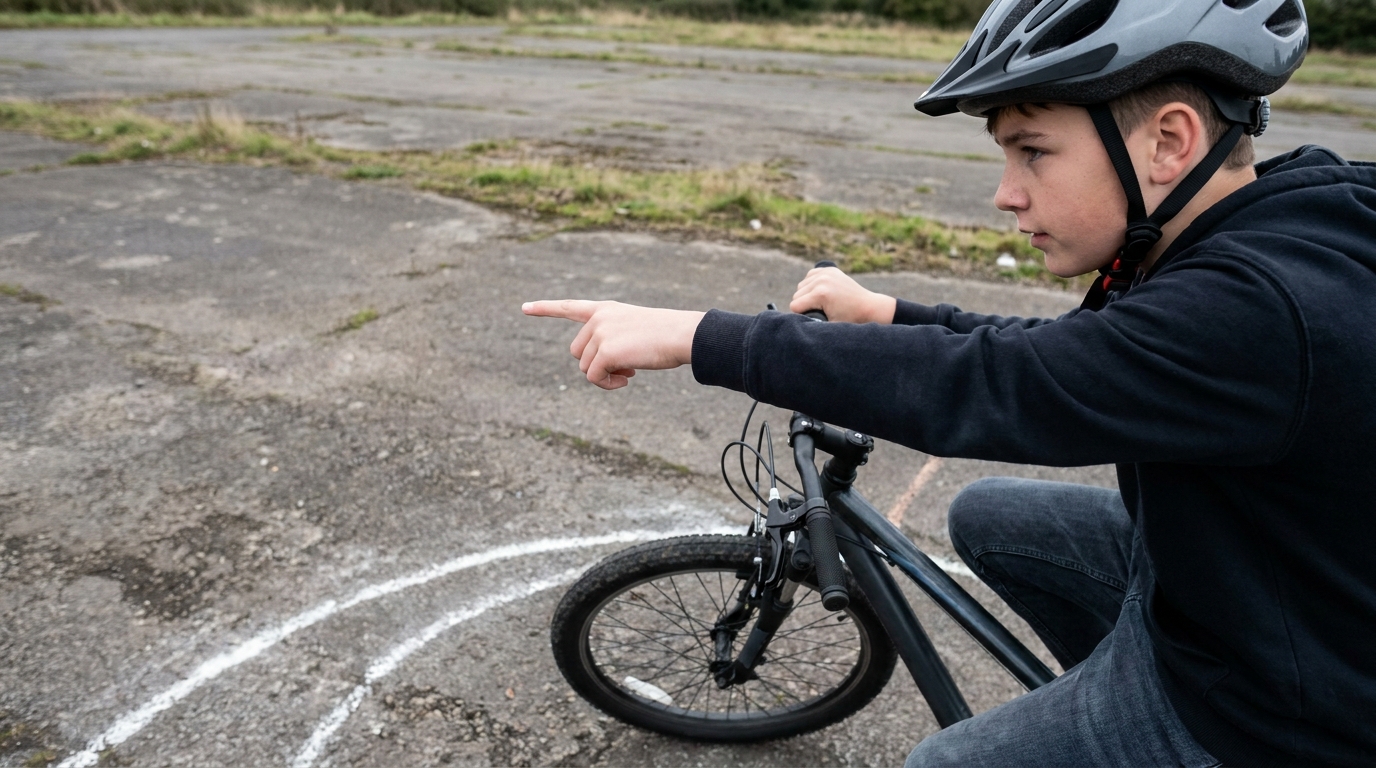
Riding along a chalk line, lift your right hand off the bar to point at something ahead. The bike tracks a slow curve to the left and the front wheel crosses the line.
That hand was off for about two seconds, which is roughly how long a signal takes. That is why signalling is a skill with a drill attached, not something you just do.
2Why this sits right next to looking behind
The same traffic-free level asks for both: look behind over each shoulder while pedalling in a straight line, and pedal one handed in a straight line. Signaling is not taught until the level after that. The ordering is not an accident.
You do not get taught to signal until you can hold a line without the hand you would be signaling with. Otherwise the signal itself becomes the hazard, and a rider communicating beautifully while drifting into a lane has made the situation worse rather than better.
3It is also what buys you a proper look
A training article makes the link exactly: you need to be able to ride one-handed for anything more than a glance behind. A quick flick of the head works with both hands on the bars. Anything longer means turning your body, and turning your body means a hand has to come off.
So these are one skill wearing two names. The hand comes off so the shoulders can turn, and the shoulders turn so your eyes can get all the way round. Practice either one properly and you get most of the other for free.
4The trade, said out loud
The national standard requires riders to understand the risks associated with giving arm signals, such as reduced stability. Notice that it is written as something you must understand, not something you must always do. That is unusual and it is deliberate.
A signal is a trade: one hand of control for one unit of communication. There are moments when that is a bad trade — a rough patch, a hard brake, a machine already moving around under you — and a rider who knows the price can decide not to pay it right then. Control of the machine comes first, always.
5You want to signal, and the road is rough.
Pick one.
Yes, and that is the trade managed rather than dodged. You spend the hand where the road is smooth and you get it back before you need it. The message still goes out, and the machine is on two hands at the moment it is hardest to ride on one.
One of those risks the machine and the other skips the message. Signaling across a rough patch is exactly the moment when one hand is not enough, and turning with no signal leaves the person behind you guessing. Move the signal in time rather than dropping it altogether.
6How long is a signal
A rider on a corridor. Choose which hand comes off and for how long, from half a second up to five, and whether you keep pedalling. The line the wheel draws stays on screen. Then a signal appears that has to be held out for two full seconds.
Try your weaker side. Nearly everybody has one, and it is usually the side they will need for the turn they make most often.
7Which of these are true about riding one-handed?
Pick every one that is right, then press Check.
Find all 4.
Four. One hand off is the price of a proper look, and it is worth paying.
Two of those are wrong. Quiet roads need it too, and a tighter grip makes it worse.
8The sentence for the rough patch
Say it out loud, in your normal voice
Signal early, hands back on.
The order is the whole content of it. The signal goes out while the road is good, and the hand comes back before the road gets bad, rather than the other way round.
9Before you leave this page
Ride one-handed, five runs with each hand.
Ride your chalk corridor one-handed, five runs with the left hand off and five with the right, holding it off for a slow count of two each time, with somebody watching the front wheel. Then do five more where the hand that comes off makes a real signal, held out straight, while the line stays where it was.