
Ready Kids › Road Badge › Badge 1 › Lesson 1.1
All courses›Road Badge›Badge 1
What you are actually riding
Say which class your machine is, what a throttle does that pedal assist does not, and why the mass and the held speed change how far you need to stop.
1Watch
Two machines leave the same driveway
Same street, same push off, same rider effort. Watch how much of the block has gone by the time the film stops.
2The idea
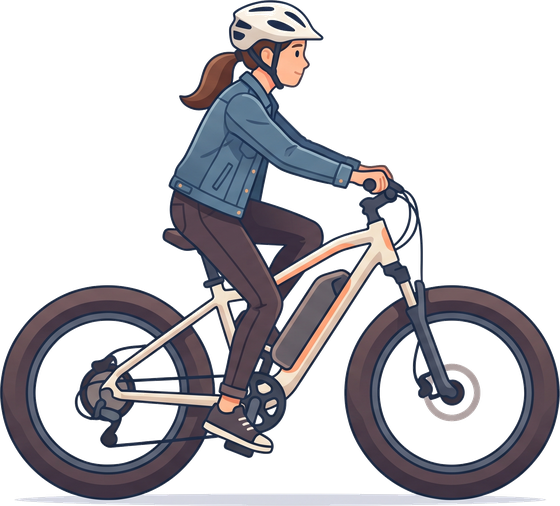
It is filed as a bicycle. It is not built like one.
A conventional bicycle weighs about what you can carry up a flight of stairs in one hand. An e-bike is 30 to 60 pounds. The motor does the pushing, so that weight never argues with you while you are moving. It shows up when you want to stop, and when the machine goes down.
US e-bike motors are typically three times more powerful than the ones allowed in Europe and the rest of the world — 750 watts against 250 to 400. Whatever you are riding, it sits at the strong end of what anybody anywhere calls an e-bike.
3The idea
Your legs used to be the speedometer
On a pedal bike, going faster costs you something. Your breathing tells you roughly how fast you are going, and you slow down because you are tired rather than because you decided to. That feedback is the thing you actually learned to ride by.
A motor never gets tired. It holds the speed all the way to the junction, and it holds it up the hill. So the feedback is gone, and the number printed on the frame label is now the only honest thing on the machine.
4Look
Three classes, and what the number means
The motor only helps while you are actually pedalling, and it cuts out at 20 mph.
Can deliver power with no pedalling at all. Cuts out at the same 20 mph.
In Illinois a Class 3 has to carry a speedometer, and permanent labelling of its classification, its speed and its wattage.
Class 1 is pedal assist only and the motor cuts out at 20 mph. Class 2 has a throttle and cuts out at the same 20. Class 3 assists to 28, and in Illinois a Class 3 has to carry a speedometer and permanent labelling of its classification, speed and wattage.
There are three classes, and the number tells you what you have got. Class one is pedal assist only, and the motor cuts out at twenty miles an hour. Class two has a throttle, and cuts out at the same twenty. Class three assists all the way to twenty-eight. And in Illinois, a class three has to carry a speedometer, and permanent labelling of its classification, its speed and its wattage.
5The idea
What a throttle actually changes
Pedal assist only adds power while you are already pedalling, so the machine cannot go anywhere until you are on it and turning the cranks. A throttle is different. It delivers power with no rider input at all.
Which means the machine can be moving before you are balanced on it. Massachusetts Safe Routes to School puts it in one line: throttle-powered e-bikes can accelerate quickly, so start slow and stay in control. First rides on a new machine belong in an empty parking lot, away from other people.
6Decide
You are sitting on a Class 2, one foot still down, and your thumb finds the throttle.
Have a go at this one. You are sitting on a class two, one foot still down, and your thumb finds the throttle. What happens next?
Pick one to carry on.
7The idea
Why the stop is the part that changes
At a steady speed you decide, then you brake
At twice that speed the deciding doubles – the braking goes up around four times
The grey bar is the ground you cover while you are still deciding. The orange bar is the ground you cover once you are actually braking. The grey bar doubled. The orange bar went up around four times.
Two separate things get longer. The first is the rolling you do while you are still deciding: from the moment you see the problem to the moment your hands squeeze, you keep going, and at a higher speed you cover more ground doing nothing.
Then the braking itself. Double the speed and the braking distance goes up around four times, because the energy you have to get rid of climbs with the square of the speed. That is ordinary physics. It does not care how easy the machine felt on the way there.
Now the part that changes most. Two separate things get longer. The first is the rolling you do while you are still deciding. From the moment you see the problem to the moment your hands squeeze, you keep going, and at a higher speed you cover more ground doing nothing at all. Then the braking itself. Double the speed, and the braking distance goes up around four times, because the energy you have to get rid of climbs with the square of the speed. That is ordinary physics. It does not care how easy the machine felt on the way there.
8Find them
Which of these make the stop longer?
Which of these make the stop longer? There are four of them. Take your time.
Tap the ones that count.
Find all 4.
9Your turn
Where you end up
Drag it slowly and watch which bar grows fastest.
Drag it slowly, and watch which of the two bars grows fastest.
Drag the slider slowly, from walking pace up to the top assisted speed of each class. Two bars grow as you drag. One is the ground you cover while you are still deciding. The other is the ground you cover braking. Watch which one grows fastest.
10Do it
Before you leave this page
Go out to your machine, switch the motor off, and push it up the drive by the bars. That is the weight the brakes deal with, before you add yourself to it. Then find the frame label and read the class number out loud.
Tick it when you have done it.
Lesson done.
It is filed as a bicycle and it looks like a bicycle. It does not weigh like one and it does not hold speed like one.
Next lesson: Which class is yours, and what the law says